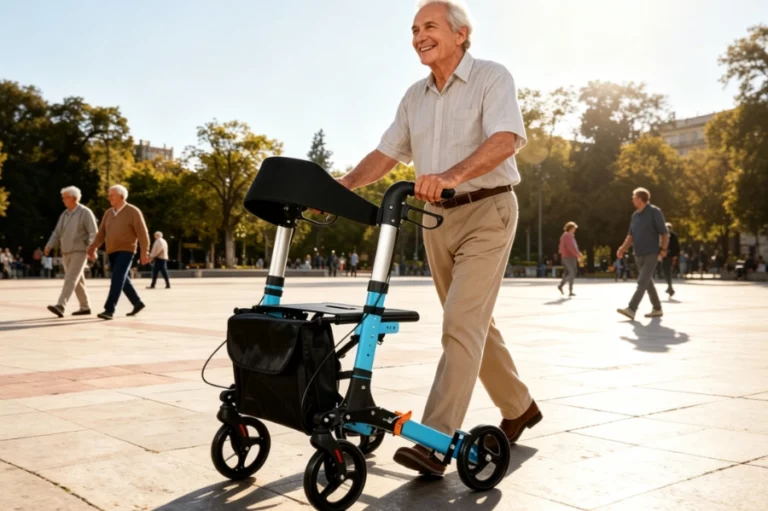
Managing the intricate domain of healthcare support equipment demands far more than a cursory review of cost listings. For commercial importers, the implications encompass regulatory accountability and patient protection. Quality assurance transcends mere terminology. It separates a thriving inventory from a stockpile burdened by withdrawals. Beiqin emerges as an established leader in this field. It draws on 16 years of substantial knowledge in producing recovery aids. From its 20,000㎡ automated plant, this certified High-Tech Enterprise generates over 6,000 pieces each day. It supplies major international players and targeted healthcare vendors in more than 50 regions. Entities pursuing large-scale OEM/ODM services or swift 3-day model development gain from a tradition of exact fabrication. They also access a 180,000-unit reserve. This manufacturing magnitude, paired with a “temperature-driven” approach to design, positions Beiqin as a solid foundation for any sourcing strategy. Such capabilities ensure consistent delivery and compliance in global operations.
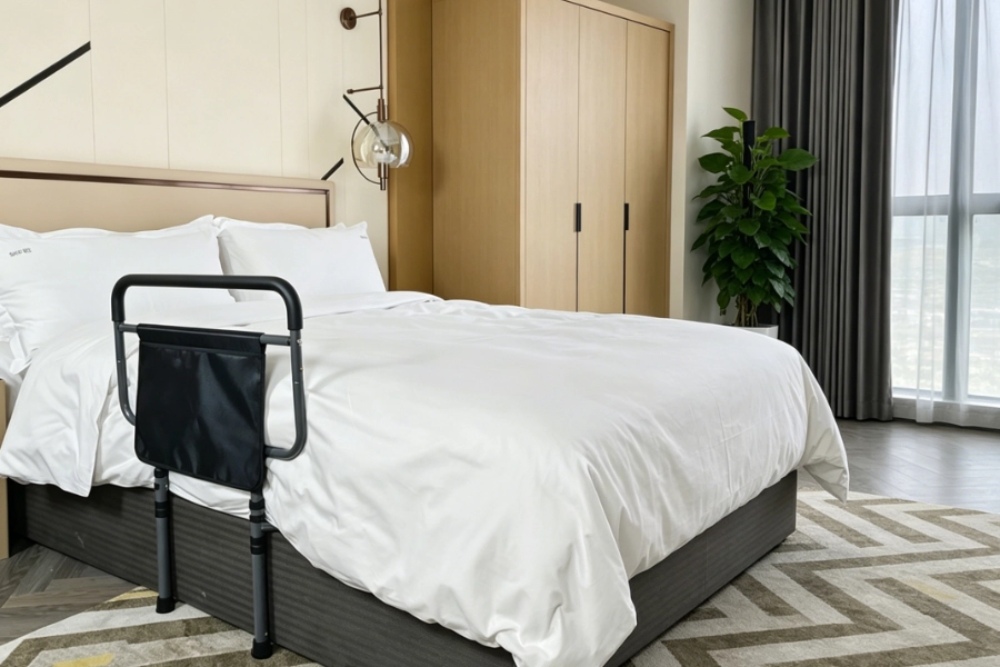
Cross-border commerce necessitates rigorous conformity to territorial accreditations. This avoids border holdups or judicial sanctions. Numerous sectors classify these protective tools as Class I therapeutic instruments. Thus, paperwork must exhibit perfection prior to any dispatch departing the port. Importers who prioritize these elements maintain seamless trade flows. They also shield against potential disruptions in their supply networks.
ASTM F2085 serves as the core reference for bed rail protection. It concentrates on averting entrapment incidents. ISO 13485 accreditation confirms that a production site upholds a stringent quality oversight framework tailored to therapeutic apparatus. These benchmarks guide manufacturers in achieving dependable performance. They also assist importers in selecting verified suppliers for sustained reliability.
Vendors in Europe face legal prohibitions on distributing support devices absent the CE designation. This attestation indicates conformity to wellness, security, and ecological safeguards across the EEA. Compliance with this requirement facilitates market access. It further minimizes exposure to regulatory fines or product seizures in that jurisdiction.
Categorization governs the degree of oversight from authorities. The majority of manual bed rails belong to minimal hazard groups. Nevertheless, they demand official enrollment with entities such as the FDA or MHRA. This process ensures traceability and accountability. It supports importers in navigating diverse international frameworks effectively.
Outcomes from impartial laboratories like SGS or TUV furnish essential evidence of robustness. Commercial buyers ought to obtain the primary digital documents. They should avoid depending solely on textual overviews. Such verification bolsters confidence in product integrity. It also aids in defending against liability claims during audits.
The mechanical robustness of a rail dictates its efficacy amid nocturnal instability. A fragile structure proves more hazardous than its absence. It instills misplaced assurance that precipitates mishaps. Engineers focus on resilient designs to mitigate such risks. These approaches prioritize user welfare in vulnerable scenarios.
Many adverse events in this area arise from “gap zones” that trap users. Protocols specify that spaces amid rail elements or between the rail and bedding adhere to precise dimensional constraints. This precision prevents bodily wedging. It thereby enhances overall protective efficacy in clinical applications.
Conventional models must endure 250 to 300 pounds sans lasting distortion. Premium Bed Rails Bedside Grab Bar variants employ fortified carbon steel to fulfill these demanding specifications. Such materials ensure structural resilience. They accommodate varied user profiles without compromise.
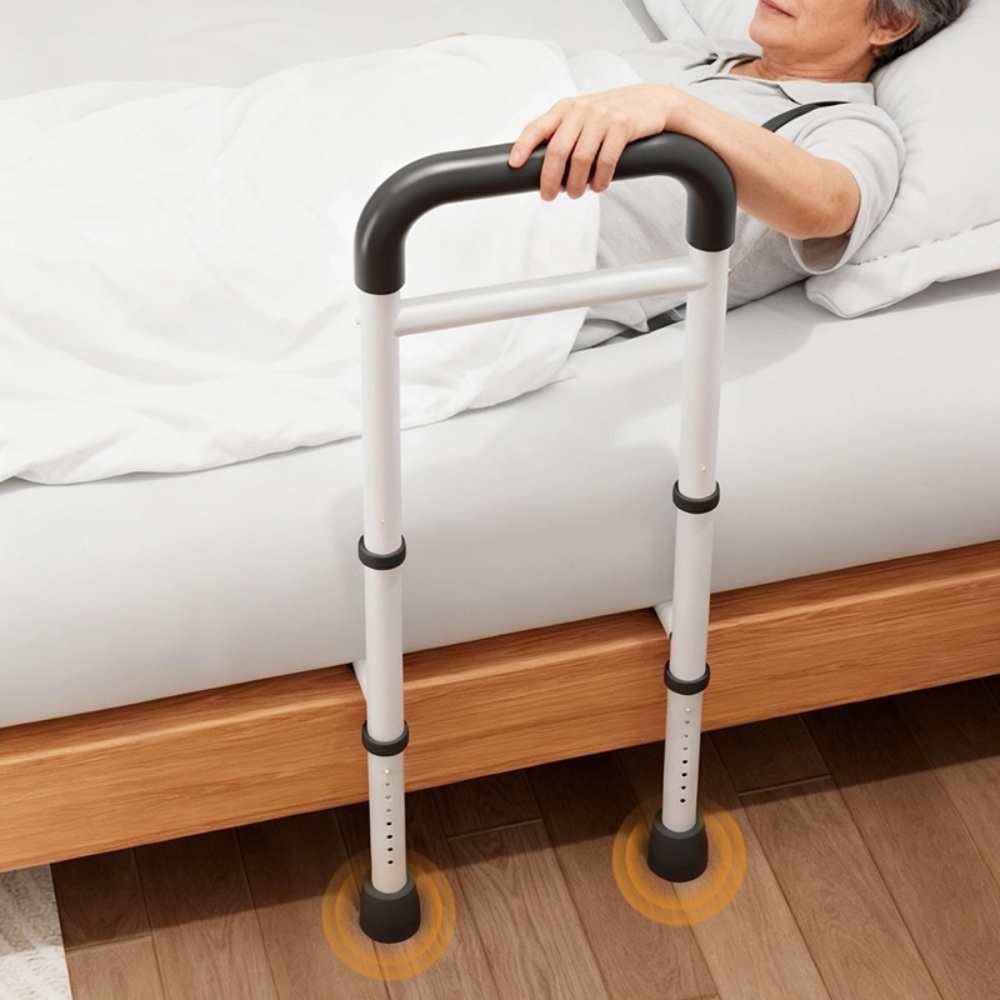
Carbon steel provides an enhanced durability-to-mass balance over elementary iron. It resists cyclic loading without fractures at joint areas. This contrasts with inferior options prone to early degradation. Consequently, it extends service life in intensive care settings.
Evaluations apply sideways forces to mimic full-body reliance on the grip. Should the foundation shift or the rail deviate beyond minimal angles, the configuration violates protective guidelines. Rigorous testing identifies weaknesses early. It refines designs for superior performance in real-world conditions.
Device protection encompasses the elemental makeup of employed substances. Given extended dermal interaction, the surface treatment must match the framework’s reliability. Protocols address both immediate hazards and long-term ecological impacts. They promote safe, sustainable practices in production.
Reputable facilities apply lead-absent electrostatic coatings that withstand abrasion and oxidation. This averts hazardous particulates from entering the body or causing irritation. Such finishes maintain aesthetic and functional integrity. They align with health regulations for patient-facing equipment.
Grips represent frequent contact points susceptible to microbial accumulation. Incorporating therapeutic-grade elastomer or padding with anti-bacterial agents preserves sanitation in extended care facilities. These features reduce infection transmission risks. They support hygienic protocols in institutional environments.
Inferior foam degrades rapidly, revealing underlying metal. Dense EVA or NBR variants endure for extended durations. They deliver reliable, traction-enhanced handling. This consistency bolsters user confidence and device longevity.
An item’s security hinges on accurate caregiver setup. Intricate configurations frequently provoke errors. Hence, straightforward engineering constitutes a practical safeguard. It facilitates correct deployment across diverse user competencies.
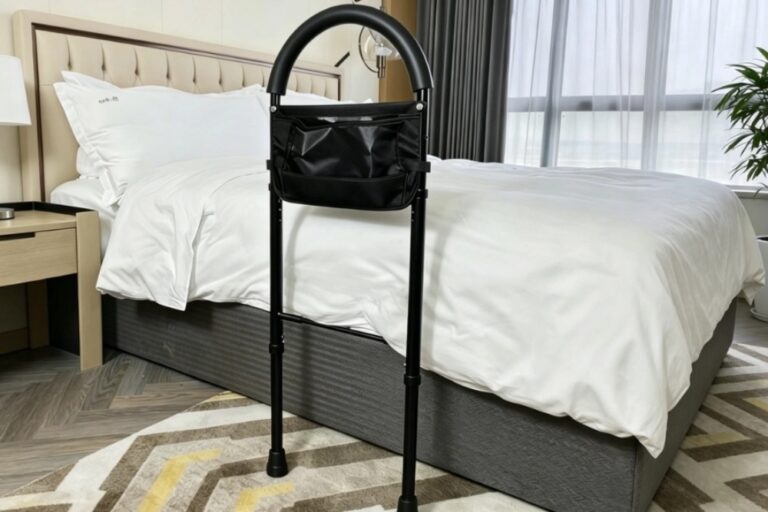
Contemporary Bed Assist Grab Bar Handle with Storage Pocket incorporate clamp or latch-based systems. These enable firm installation sans specialized implements. Such simplicity accelerates adoption. It minimizes assembly-related incidents in home care scenarios.
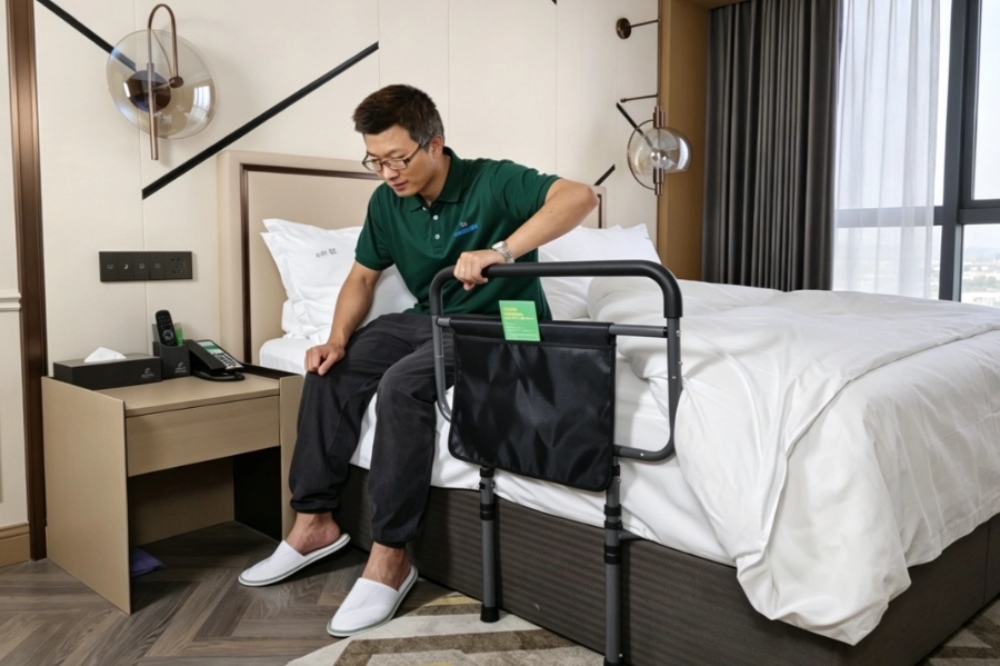
Bed sizes differ regionally, complicating uniformity. Protective rails necessitate adaptable footings to span from single to oversized structures. This versatility ensures broad applicability. It accommodates international variations without modifications.
Optimal stability derives from retention bands encircling the bed skeleton. These inhibit gradual displacement beneath the bedding. Reliable anchoring preserves positioning integrity. It prevents unintended shifts during usage.
Handle contours should align with mature hand ergonomics. This alignment eases joint burdens in positional changes. Thoughtful shaping enhances accessibility. It promotes independent mobility for aging populations.
For expanding operations, a producer’s engineering prowess equals the item’s merits. Dependable logistics rest on sites capable of surging output. They preserve quality verification amid fluctuations. This equilibrium drives efficient scaling for partners.
Equipped with over 60 specialized instruments and four sophisticated production pathways, the site manages an annual output of 2.3 million items. This setup fosters quick advancements and refinement of protective innovations. It enables tailored solutions. Such resources empower collaborative development in the sector.
Commercial partners frequently require region-specific alterations. Model creation occurs in three days. Bulk requests of 10,000 units dispatch within a week. This agility meets urgent demands. It sustains competitive advantages in wholesale channels.
Guidance extends beyond dispatch terminals. Esteemed producers offer comprehensive service support. This includes upkeep directives and promotional materials for vendors. Ongoing aid fortifies relationships. It ensures product viability post-delivery.
Intelligent transport frameworks permit 12-hour fulfillment for available stock. Each lot receives twofold scrutiny via machinery and human oversight. This upholds “life-temperature” excellence. It guarantees traceability and conformity in worldwide distributions.
Uninformed acquisitions invite catastrophe. Savvy procurers assess providers via electronic reviews and tangible records. This diligence curtails exposures. It fosters resilient procurement practices in competitive landscapes.
ISO 9001 or BSCI evaluations reveal labor and quality practices. These records prove indispensable for premium retail alliances. Thorough examination validates ethical standards. It mitigates reputational risks for importers.
Superior rails endure 15 or more years of application. Soliciting endurance assessment figures assesses endurance in facility contexts. This data informs longevity projections. It aids in forecasting maintenance needs accurately.
Protection depends on effective conveyance. Guides require lucidity, visuals, and precise translations for recipient languages. This clarity averts misapplications. It reinforces safe utilization across linguistic boundaries.
Q1: What is the most common safety failure in imported bed rails?
A: The most frequent issue is “entrapment gaps” where the spacing between the rail and the mattress allows a user’s head or limbs to become stuck, which is why ASTM compliance is so critical.
Q2: Can these bed rails be used on adjustable electric beds?
A: Not all models are compatible. Importers must verify the base design; specifically, collapsible models are usually better suited for adjustable frames to avoid mechanical interference.
Q3: Is carbon steel better than aluminum for medical rails?
A: Carbon steel is generally preferred for stationary safety rails due to its higher rigidity and weight, which provides a more grounded feel for the user compared to lightweight aluminum.
Q4: How do I verify if a factory’s CE certificate is authentic?
A: You should check the certificate number against the issuing body’s online database. Reliable manufacturers will always provide the contact details of the certifying agency.
Q5: What is the benefit of a “tool-free” installation for a distributor?
A: It significantly reduces product returns. Most consumer complaints stem from difficult assembly; a tool-free design ensures the product is used correctly and safely right out of the box.
Managing the intricate domain of healthcare support equipment demands far more than a cursory review of cost listings. For commercial importers, the implications encompass regulatory accountability and patient protection. Quality assurance transcends mere terminology. It separates a thriving inventory from a stockpile burdened by withdrawals. Beiqin emerges as an established leader in this field. It draws on 16 years of substantial knowledge in producing recovery aids. From its 20,000㎡ automated plant, this certified High-Tech Enterprise generates over 6,000 pieces each day. It supplies major international players and targeted healthcare vendors in more than 50 regions. Entities pursuing large-scale OEM/ODM services or swift 3-day model development gain from a tradition of exact fabrication. They also access a 180,000-unit reserve. This manufacturing magnitude, paired with a “temperature-driven” approach to design, positions Beiqin as a solid foundation for any sourcing strategy. Such capabilities ensure consistent delivery and compliance in global operations.
Cross-border commerce necessitates rigorous conformity to territorial accreditations. This avoids border holdups or judicial sanctions. Numerous sectors classify these protective tools as Class I therapeutic instruments. Thus, paperwork must exhibit perfection prior to any dispatch departing the port. Importers who prioritize these elements maintain seamless trade flows. They also shield against potential disruptions in their supply networks.
ASTM F2085 serves as the core reference for bed rail protection. It concentrates on averting entrapment incidents. ISO 13485 accreditation confirms that a production site upholds a stringent quality oversight framework tailored to therapeutic apparatus. These benchmarks guide manufacturers in achieving dependable performance. They also assist importers in selecting verified suppliers for sustained reliability.
Vendors in Europe face legal prohibitions on distributing support devices absent the CE designation. This attestation indicates conformity to wellness, security, and ecological safeguards across the EEA. Compliance with this requirement facilitates market access. It further minimizes exposure to regulatory fines or product seizures in that jurisdiction.
Categorization governs the degree of oversight from authorities. The majority of manual bed rails belong to minimal hazard groups. Nevertheless, they demand official enrollment with entities such as the FDA or MHRA. This process ensures traceability and accountability. It supports importers in navigating diverse international frameworks effectively.
Outcomes from impartial laboratories like SGS or TUV furnish essential evidence of robustness. Commercial buyers ought to obtain the primary digital documents. They should avoid depending solely on textual overviews. Such verification bolsters confidence in product integrity. It also aids in defending against liability claims during audits.
The mechanical robustness of a rail dictates its efficacy amid nocturnal instability. A fragile structure proves more hazardous than its absence. It instills misplaced assurance that precipitates mishaps. Engineers focus on resilient designs to mitigate such risks. These approaches prioritize user welfare in vulnerable scenarios.
Many adverse events in this area arise from “gap zones” that trap users. Protocols specify that spaces amid rail elements or between the rail and bedding adhere to precise dimensional constraints. This precision prevents bodily wedging. It thereby enhances overall protective efficacy in clinical applications.
Conventional models must endure 250 to 300 pounds sans lasting distortion. Premium Bed Rails Bedside Grab Bar variants employ fortified carbon steel to fulfill these demanding specifications. Such materials ensure structural resilience. They accommodate varied user profiles without compromise.
Carbon steel provides an enhanced durability-to-mass balance over elementary iron. It resists cyclic loading without fractures at joint areas. This contrasts with inferior options prone to early degradation. Consequently, it extends service life in intensive care settings.
Evaluations apply sideways forces to mimic full-body reliance on the grip. Should the foundation shift or the rail deviate beyond minimal angles, the configuration violates protective guidelines. Rigorous testing identifies weaknesses early. It refines designs for superior performance in real-world conditions.
Device protection encompasses the elemental makeup of employed substances. Given extended dermal interaction, the surface treatment must match the framework’s reliability. Protocols address both immediate hazards and long-term ecological impacts. They promote safe, sustainable practices in production.
Reputable facilities apply lead-absent electrostatic coatings that withstand abrasion and oxidation. This averts hazardous particulates from entering the body or causing irritation. Such finishes maintain aesthetic and functional integrity. They align with health regulations for patient-facing equipment.
Grips represent frequent contact points susceptible to microbial accumulation. Incorporating therapeutic-grade elastomer or padding with anti-bacterial agents preserves sanitation in extended care facilities. These features reduce infection transmission risks. They support hygienic protocols in institutional environments.
Inferior foam degrades rapidly, revealing underlying metal. Dense EVA or NBR variants endure for extended durations. They deliver reliable, traction-enhanced handling. This consistency bolsters user confidence and device longevity.
An item’s security hinges on accurate caregiver setup. Intricate configurations frequently provoke errors. Hence, straightforward engineering constitutes a practical safeguard. It facilitates correct deployment across diverse user competencies.
Contemporary Bed Assist Grab Bar Handle with Storage Pocket incorporate clamp or latch-based systems. These enable firm installation sans specialized implements. Such simplicity accelerates adoption. It minimizes assembly-related incidents in home care scenarios.
Bed sizes differ regionally, complicating uniformity. Protective rails necessitate adaptable footings to span from single to oversized structures. This versatility ensures broad applicability. It accommodates international variations without modifications.
Optimal stability derives from retention bands encircling the bed skeleton. These inhibit gradual displacement beneath the bedding. Reliable anchoring preserves positioning integrity. It prevents unintended shifts during usage.
Handle contours should align with mature hand ergonomics. This alignment eases joint burdens in positional changes. Thoughtful shaping enhances accessibility. It promotes independent mobility for aging populations.
For expanding operations, a producer’s engineering prowess equals the item’s merits. Dependable logistics rest on sites capable of surging output. They preserve quality verification amid fluctuations. This equilibrium drives efficient scaling for partners.
Equipped with over 60 specialized instruments and four sophisticated production pathways, the site manages an annual output of 2.3 million items. This setup fosters quick advancements and refinement of protective innovations. It enables tailored solutions. Such resources empower collaborative development in the sector.
Commercial partners frequently require region-specific alterations. Model creation occurs in three days. Bulk requests of 10,000 units dispatch within a week. This agility meets urgent demands. It sustains competitive advantages in wholesale channels.
Guidance extends beyond dispatch terminals. Esteemed producers offer comprehensive service support. This includes upkeep directives and promotional materials for vendors. Ongoing aid fortifies relationships. It ensures product viability post-delivery.
Intelligent transport frameworks permit 12-hour fulfillment for available stock. Each lot receives twofold scrutiny via machinery and human oversight. This upholds “life-temperature” excellence. It guarantees traceability and conformity in worldwide distributions.
Uninformed acquisitions invite catastrophe. Savvy procurers assess providers via electronic reviews and tangible records. This diligence curtails exposures. It fosters resilient procurement practices in competitive landscapes.
ISO 9001 or BSCI evaluations reveal labor and quality practices. These records prove indispensable for premium retail alliances. Thorough examination validates ethical standards. It mitigates reputational risks for importers.
Superior rails endure 15 or more years of application. Soliciting endurance assessment figures assesses endurance in facility contexts. This data informs longevity projections. It aids in forecasting maintenance needs accurately.
Protection depends on effective conveyance. Guides require lucidity, visuals, and precise translations for recipient languages. This clarity averts misapplications. It reinforces safe utilization across linguistic boundaries.
Q1: What is the most common safety failure in imported bed rails?
A: The most frequent issue is “entrapment gaps” where the spacing between the rail and the mattress allows a user’s head or limbs to become stuck, which is why ASTM compliance is so critical.
Q2: Can these bed rails be used on adjustable electric beds?
A: Not all models are compatible. Importers must verify the base design; specifically, collapsible models are usually better suited for adjustable frames to avoid mechanical interference.
Q3: Is carbon steel better than aluminum for medical rails?
A: Carbon steel is generally preferred for stationary safety rails due to its higher rigidity and weight, which provides a more grounded feel for the user compared to lightweight aluminum.
Q4: How do I verify if a factory’s CE certificate is authentic?
A: You should check the certificate number against the issuing body’s online database. Reliable manufacturers will always provide the contact details of the certifying agency.
Q5: What is the benefit of a “tool-free” installation for a distributor?
A: It significantly reduces product returns. Most consumer complaints stem from difficult assembly; a tool-free design ensures the product is used correctly and safely right out of the box.