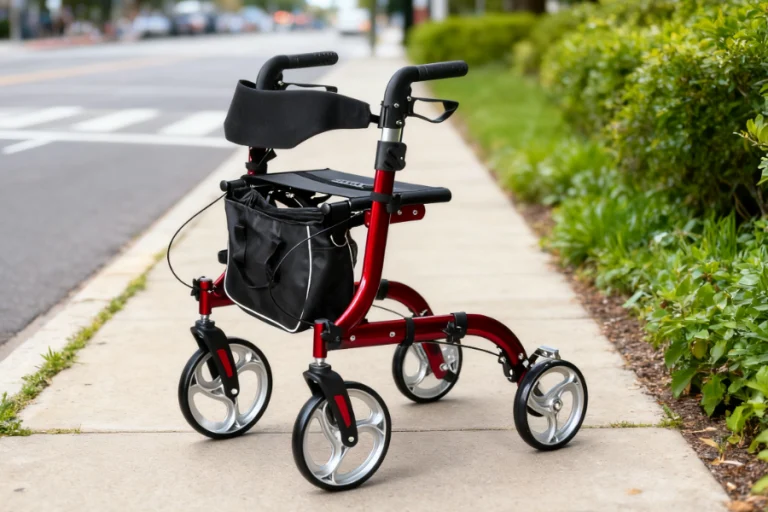
Rollator sourcing looks simple on a quotation sheet, but the real cost often appears later: slow moving stock, user complaints, unstable batches, missing certificates, or packaging that fails during long distance delivery. For medical equipment importers, rehabilitation distributors, pharmacy chains, elderly care suppliers, and private label brands, a rollator is not just a walking aid. It is a daily safety product used by seniors, disabled users, and recovery patients.
Beiqin brings 16 years of experience in age friendly assistive devices, with a 20,000 square meter digital smart factory, more than 60 professional machines, over 210 employees, daily production of 6,000 plus units, and ready stock reaching 180,000 units. The company covers rollators, walkers, mobility scooters, wheelchairs, knee scooters, commode chairs, shower chairs, safety rails, toilet risers, canes, crutches, and rehabilitation equipment. Its About Us page also shows a factory model built around R&D, production, sales, quality systems, and global delivery.
The following guide lists ten rollator sourcing mistakes that often create trouble for importers. Some are technical. Some are commercial. A few look small at first. In real B2B procurement, small details usually decide whether a product becomes a repeat order or a headache.
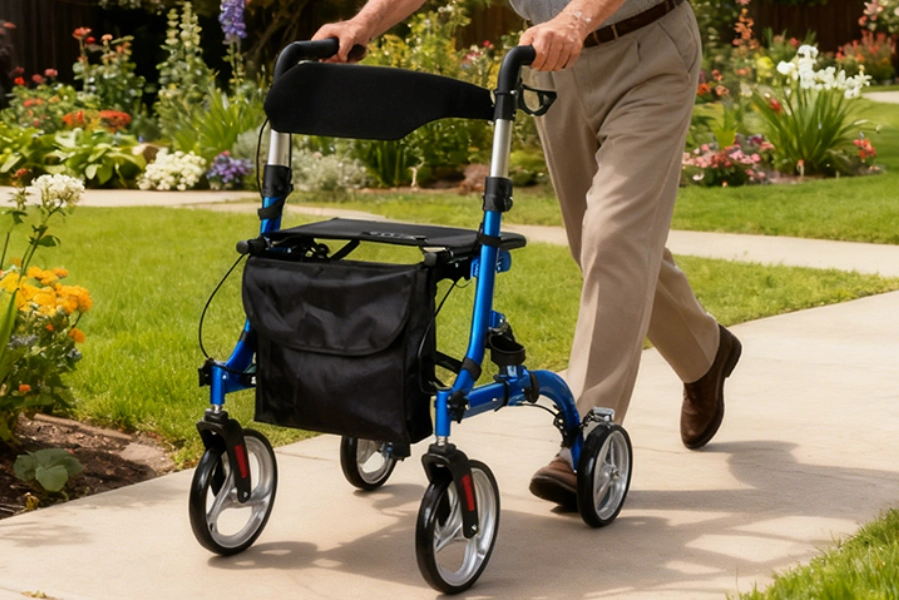
A rollator has to match real users, real care settings, and real sales channels. A model that works well in a rehab center may not be the best choice for home care retail. A product that looks attractive in a catalogue may still fail if handle height, wheel size, weight, or folding style does not match the target market.
Many importers start by asking for the lowest unit price. That is normal, but it can push the sourcing process in the wrong direction. A rollator used in home care needs easy folding, light weight, stable braking, and simple storage. A rollator supplied to institutional care may need stronger structure, wider seating support, and a layout that nursing staff can handle quickly.
Beiqin’s solution category separates mobility aids, bathing and toileting safety aids, daily living assistive devices, rehabilitation equipment, and elderly safety products. This matters because rollator buyers rarely source one isolated item for long. Many clients build a full elderly care product line, so product fit should come before price trimming.
Indoor use often needs easy turning, compact folding, and clean storage. Outdoor use asks more from wheels, frame balance, handle adjustment, and vibration control. A rollator that feels smooth on flat indoor floors may feel harsh on stone paths, ramps, or uneven community roads.
The safer sourcing habit is to define the main use case first. Retail partners may need one lightweight model for apartments and one stronger model for mixed indoor and outdoor use. A distributor serving elderly care centers may need models that are easy to clean, easy to park, and clear to train. Not glamorous, but it saves after sales work.
Rollator importers often compare photos and prices before reading the material table. That is risky. A rollator is built from frame, armrest, seat, wheels, brake, folding joints, and accessories. If one part is weak, the whole product feels cheap even when the frame looks good.
A lightweight rollator should not feel flimsy. Beiqin’s rollator catalogue uses aluminum frames across many models, with PVC armrests, Textilene seats, and linear pull brakes in multiple assisted walking designs. The common load capacity shown across several rollator models is 136 kg. That gives importers a practical baseline when screening models for senior care and disability aid channels.
Weight also affects sales. If the rollator is too heavy, users struggle with transport and storage. If it is too light without enough structural support, buyers may question durability. Beiqin’s manufacturing base uses precision equipment, strict material screening, stamping and welding processes, and lightweight aluminum or carbon fiber design experience. For buyers building a long term rollator line, that factory background matters more than a small price cut.
Brake details are not decoration. The knowledge base makes a clear point: wheeled walking aids should stay flexible while keeping good braking performance. For elderly users with weaker balance, brake response affects confidence, especially when sitting down, standing up, or slowing on a slope.
Linear pull brakes are used across many Beiqin rollator models. For higher comfort models, wheel configuration can add real value. The Foldable Rollator 1006F uses a 10 inch front PVC wheel, an 8 inch rear PVC wheel, and a shock absorb spring. That kind of detail should appear in the sourcing sheet, not only in marketing copy.
Comfort is not a soft feature in medical equipment trade. It affects product reviews, return rates, and dealer confidence. Seniors may use a rollator every day, and a small discomfort can quickly become a complaint. The better buying teams look at support, sitting, carrying, storage, and noise.
A rollator seat is not only for rest. It affects how users trust the product. Seat material, width, backrest feel, and parking stability all play a role. Beiqin catalogue models use Textilene seats in many rollators, while some models include footrests, footplates, bags, or collapsible parts. These are not minor extras for B2B clients. They help build clear product tiers for dealers.
A simple example from retail feedback is easy to see: users remember whether the seat feels stable when waiting at a clinic, outside a store, or in a care facility corridor. Not a fancy point, just a very human one.
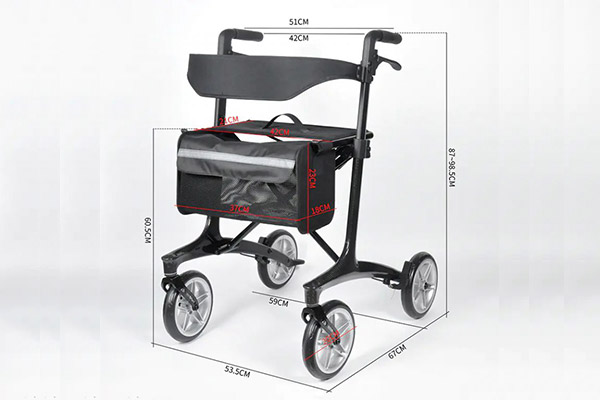
For importers targeting markets with varied sidewalks, ramps, garden paths, or older community buildings, shock absorption can become a selling point. Beiqin’s Lightweight Mobility Walking Aid Walkers Rollator with Shock Absorber for Disabled is model 1006F. It uses an aluminum frame, adjustable handle height from 85 to 102 cm, product size L56 x W71 x H85 to 102 cm, 8.6 kg net weight, 10.1 kg gross weight, 45 x 24 x 57 cm carton size, 136 kg max weight, and MOQ of 100 pieces.
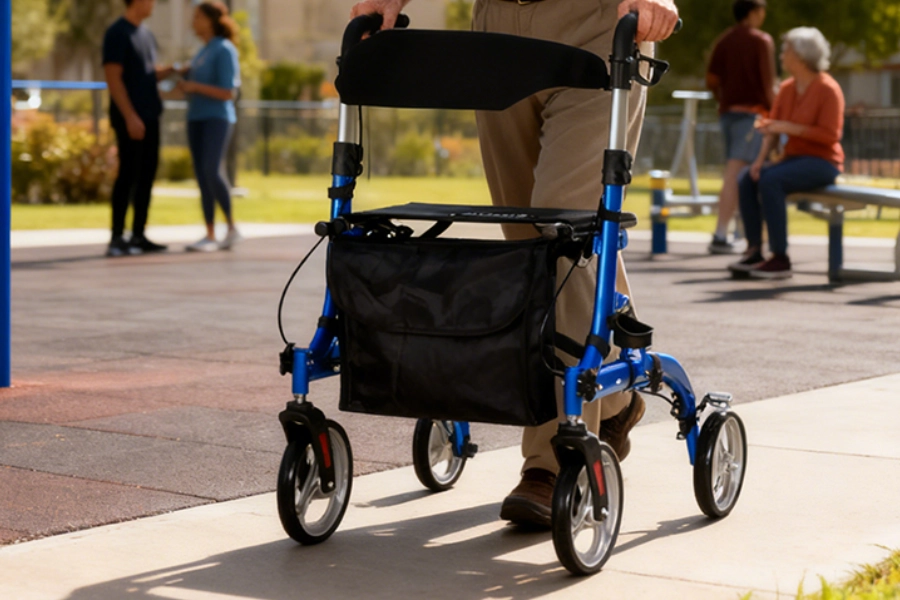
The model also has one click folding, a storage bag, upgraded shock absorbers, and a fold flat structure for easier transport and storage. For importers, this kind of model fits a mid to high value mobility aid line where the product story is based on comfort, portability, and safer daily movement rather than only low price.
Medical equipment importers deal with more than product shape. Certificates, quality systems, labels, packaging, user instructions, and batch records affect customs clearance, channel approval, and buyer trust. Missing paperwork can delay a shipment even when the product itself is ready.
A supplier saying “certificate available” is not enough. Procurement teams need exact certificate types, valid documents, product scope, and target market fit. Beiqin lists FDA, ISO 13485, BSCI, MDR, MDD, UKCA, SGS, and CE for the 1006F rollator product page. Company information also covers ISO 13485, ISO 9001, CE, RoHS, MDR, UKCA, FDA, BSCI, ISO 14001, and ISO 45001 related systems and approvals.
This does not mean every model fits every local rule automatically. Importers should still request documents before payment, check whether the certificate covers the chosen model or category, and confirm labeling needs. Good suppliers will not be surprised by that request.
A rollator that looks profitable can become costly when carton size, gross weight, and loading plans are ignored. The 1006F carton size is 45 x 24 x 57 cm, with 1 piece per carton and gross weight of 10.1 kg. Those figures affect freight, warehouse shelf planning, and distributor handling.
The Service and Support section provides catalogue download access for elderly care assistive devices, including rollator and shower chair materials. Importers should use catalogues to compare carton data, model codes, accessories, and packaging notes before locking a purchase order. It is not exciting work, but it prevents expensive surprises.
A rollator program is rarely finished with one order. If sales go well, buyers need repeat supply, stable finish, clear spare parts support, and fast answers. A supplier without capacity may deliver the first order, then struggle with a second batch before the retail season.
Private label buyers often need color changes, logo placement, packaging design, instruction manuals, barcodes, and sometimes structure changes. This is where supplier engineering ability becomes important. Beiqin’s OEM and ODM support is built for age friendly assistive technologies, with R&D, manufacturing, quality control, and supply chain coordination.
The knowledge base notes 3 day prototyping and 7 day delivery for 10,000 unit level orders. It also lists 4 advanced assembly lines and annual capacity of 2.3 million units. For medical equipment importers, this helps when launching seasonal stock, entering a new channel, or testing a custom rollator line.
Stock is not everything, but stock helps. Beiqin’s ready stock reaches 180,000 units, with 12 hour dispatch for available stock and daily packing capacity above 3,000 pieces. This gives partners more room when a buyer requests urgent replenishment.
After sales support also matters. The company’s service information includes technical support, product maintenance, flexible payment and logistics plans, and return or exchange discussion based on client needs. For importers, a stable rollator supplier should answer practical questions fast: spare parts, brake adjustment, assembly, packaging damage, certificate updates, and sample timing. A good sourcing decision is not only about the first invoice. It is about the next six months too.
Q1: What Is the Biggest Rollator Sourcing Mistake for Medical Equipment Importers?
A: The biggest mistake is choosing only by unit price before checking user scenario, frame material, brake design, wheel setup, certificates, carton size, and supplier capacity. A low price can become costly if the rollator creates complaints, shipment delays, or unstable repeat orders.
Q2: Why Is Aluminum Commonly Used in Rollator Frames?
A: Aluminum gives a useful balance between light weight and daily strength. Beiqin uses aluminum frames in many rollator models, helping importers build products that are easier to move, store, and transport while keeping a practical load capacity for senior and disabled users.
Q3: When Should Importers Choose a Rollator with Shock Absorbers?
A: A rollator with shock absorbers is a good choice for channels serving users on uneven surfaces, ramps, outdoor paths, or mixed indoor and outdoor routes. The 1006F rollator adds upgraded shock absorbers, large PVC wheels, adjustable handle height, and one click folding, making it suitable for a higher comfort product line.
Q4: What Certificates Should Be Checked Before Placing a Rollator Order?
A: Importers should check certificates based on the target market and product category. Common documents include ISO 13485, CE, FDA, UKCA, MDR, SGS, and other relevant approvals. The supplier should provide clear files, model scope, and updated validity before bulk production.
Q5: Why Is Beiqin Suitable for Rollator OEM and ODM Projects?
A: Beiqin has 16 years of experience in age friendly assistive devices, a 20,000 square meter digital smart factory, 60 plus professional machines, 6,000 plus units daily production, 180,000 units of ready stock, 3 day prototyping, and OEM/ODM support. These strengths help importers move from sample testing to bulk supply with less delay.
Rollator sourcing looks simple on a quotation sheet, but the real cost often appears later: slow moving stock, user complaints, unstable batches, missing certificates, or packaging that fails during long distance delivery. For medical equipment importers, rehabilitation distributors, pharmacy chains, elderly care suppliers, and private label brands, a rollator is not just a walking aid. It is a daily safety product used by seniors, disabled users, and recovery patients.
Beiqin brings 16 years of experience in age friendly assistive devices, with a 20,000 square meter digital smart factory, more than 60 professional machines, over 210 employees, daily production of 6,000 plus units, and ready stock reaching 180,000 units. The company covers rollators, walkers, mobility scooters, wheelchairs, knee scooters, commode chairs, shower chairs, safety rails, toilet risers, canes, crutches, and rehabilitation equipment. Its About Us page also shows a factory model built around R&D, production, sales, quality systems, and global delivery.
The following guide lists ten rollator sourcing mistakes that often create trouble for importers. Some are technical. Some are commercial. A few look small at first. In real B2B procurement, small details usually decide whether a product becomes a repeat order or a headache.
A rollator has to match real users, real care settings, and real sales channels. A model that works well in a rehab center may not be the best choice for home care retail. A product that looks attractive in a catalogue may still fail if handle height, wheel size, weight, or folding style does not match the target market.
Many importers start by asking for the lowest unit price. That is normal, but it can push the sourcing process in the wrong direction. A rollator used in home care needs easy folding, light weight, stable braking, and simple storage. A rollator supplied to institutional care may need stronger structure, wider seating support, and a layout that nursing staff can handle quickly.
Beiqin’s solution category separates mobility aids, bathing and toileting safety aids, daily living assistive devices, rehabilitation equipment, and elderly safety products. This matters because rollator buyers rarely source one isolated item for long. Many clients build a full elderly care product line, so product fit should come before price trimming.
Indoor use often needs easy turning, compact folding, and clean storage. Outdoor use asks more from wheels, frame balance, handle adjustment, and vibration control. A rollator that feels smooth on flat indoor floors may feel harsh on stone paths, ramps, or uneven community roads.
The safer sourcing habit is to define the main use case first. Retail partners may need one lightweight model for apartments and one stronger model for mixed indoor and outdoor use. A distributor serving elderly care centers may need models that are easy to clean, easy to park, and clear to train. Not glamorous, but it saves after sales work.
Rollator importers often compare photos and prices before reading the material table. That is risky. A rollator is built from frame, armrest, seat, wheels, brake, folding joints, and accessories. If one part is weak, the whole product feels cheap even when the frame looks good.
A lightweight rollator should not feel flimsy. Beiqin’s rollator catalogue uses aluminum frames across many models, with PVC armrests, Textilene seats, and linear pull brakes in multiple assisted walking designs. The common load capacity shown across several rollator models is 136 kg. That gives importers a practical baseline when screening models for senior care and disability aid channels.
Weight also affects sales. If the rollator is too heavy, users struggle with transport and storage. If it is too light without enough structural support, buyers may question durability. Beiqin’s manufacturing base uses precision equipment, strict material screening, stamping and welding processes, and lightweight aluminum or carbon fiber design experience. For buyers building a long term rollator line, that factory background matters more than a small price cut.
Brake details are not decoration. The knowledge base makes a clear point: wheeled walking aids should stay flexible while keeping good braking performance. For elderly users with weaker balance, brake response affects confidence, especially when sitting down, standing up, or slowing on a slope.
Linear pull brakes are used across many Beiqin rollator models. For higher comfort models, wheel configuration can add real value. The Foldable Rollator 1006F uses a 10 inch front PVC wheel, an 8 inch rear PVC wheel, and a shock absorb spring. That kind of detail should appear in the sourcing sheet, not only in marketing copy.
Comfort is not a soft feature in medical equipment trade. It affects product reviews, return rates, and dealer confidence. Seniors may use a rollator every day, and a small discomfort can quickly become a complaint. The better buying teams look at support, sitting, carrying, storage, and noise.
A rollator seat is not only for rest. It affects how users trust the product. Seat material, width, backrest feel, and parking stability all play a role. Beiqin catalogue models use Textilene seats in many rollators, while some models include footrests, footplates, bags, or collapsible parts. These are not minor extras for B2B clients. They help build clear product tiers for dealers.
A simple example from retail feedback is easy to see: users remember whether the seat feels stable when waiting at a clinic, outside a store, or in a care facility corridor. Not a fancy point, just a very human one.
For importers targeting markets with varied sidewalks, ramps, garden paths, or older community buildings, shock absorption can become a selling point. Beiqin’s Lightweight Mobility Walking Aid Walkers Rollator with Shock Absorber for Disabled is model 1006F. It uses an aluminum frame, adjustable handle height from 85 to 102 cm, product size L56 x W71 x H85 to 102 cm, 8.6 kg net weight, 10.1 kg gross weight, 45 x 24 x 57 cm carton size, 136 kg max weight, and MOQ of 100 pieces.
The model also has one click folding, a storage bag, upgraded shock absorbers, and a fold flat structure for easier transport and storage. For importers, this kind of model fits a mid to high value mobility aid line where the product story is based on comfort, portability, and safer daily movement rather than only low price.
Medical equipment importers deal with more than product shape. Certificates, quality systems, labels, packaging, user instructions, and batch records affect customs clearance, channel approval, and buyer trust. Missing paperwork can delay a shipment even when the product itself is ready.
A supplier saying “certificate available” is not enough. Procurement teams need exact certificate types, valid documents, product scope, and target market fit. Beiqin lists FDA, ISO 13485, BSCI, MDR, MDD, UKCA, SGS, and CE for the 1006F rollator product page. Company information also covers ISO 13485, ISO 9001, CE, RoHS, MDR, UKCA, FDA, BSCI, ISO 14001, and ISO 45001 related systems and approvals.
This does not mean every model fits every local rule automatically. Importers should still request documents before payment, check whether the certificate covers the chosen model or category, and confirm labeling needs. Good suppliers will not be surprised by that request.
A rollator that looks profitable can become costly when carton size, gross weight, and loading plans are ignored. The 1006F carton size is 45 x 24 x 57 cm, with 1 piece per carton and gross weight of 10.1 kg. Those figures affect freight, warehouse shelf planning, and distributor handling.
The Service and Support section provides catalogue download access for elderly care assistive devices, including rollator and shower chair materials. Importers should use catalogues to compare carton data, model codes, accessories, and packaging notes before locking a purchase order. It is not exciting work, but it prevents expensive surprises.
A rollator program is rarely finished with one order. If sales go well, buyers need repeat supply, stable finish, clear spare parts support, and fast answers. A supplier without capacity may deliver the first order, then struggle with a second batch before the retail season.
Private label buyers often need color changes, logo placement, packaging design, instruction manuals, barcodes, and sometimes structure changes. This is where supplier engineering ability becomes important. Beiqin’s OEM and ODM support is built for age friendly assistive technologies, with R&D, manufacturing, quality control, and supply chain coordination.
The knowledge base notes 3 day prototyping and 7 day delivery for 10,000 unit level orders. It also lists 4 advanced assembly lines and annual capacity of 2.3 million units. For medical equipment importers, this helps when launching seasonal stock, entering a new channel, or testing a custom rollator line.
Stock is not everything, but stock helps. Beiqin’s ready stock reaches 180,000 units, with 12 hour dispatch for available stock and daily packing capacity above 3,000 pieces. This gives partners more room when a buyer requests urgent replenishment.
After sales support also matters. The company’s service information includes technical support, product maintenance, flexible payment and logistics plans, and return or exchange discussion based on client needs. For importers, a stable rollator supplier should answer practical questions fast: spare parts, brake adjustment, assembly, packaging damage, certificate updates, and sample timing. A good sourcing decision is not only about the first invoice. It is about the next six months too.
Q1: What Is the Biggest Rollator Sourcing Mistake for Medical Equipment Importers?
A: The biggest mistake is choosing only by unit price before checking user scenario, frame material, brake design, wheel setup, certificates, carton size, and supplier capacity. A low price can become costly if the rollator creates complaints, shipment delays, or unstable repeat orders.
Q2: Why Is Aluminum Commonly Used in Rollator Frames?
A: Aluminum gives a useful balance between light weight and daily strength. Beiqin uses aluminum frames in many rollator models, helping importers build products that are easier to move, store, and transport while keeping a practical load capacity for senior and disabled users.
Q3: When Should Importers Choose a Rollator with Shock Absorbers?
A: A rollator with shock absorbers is a good choice for channels serving users on uneven surfaces, ramps, outdoor paths, or mixed indoor and outdoor routes. The 1006F rollator adds upgraded shock absorbers, large PVC wheels, adjustable handle height, and one click folding, making it suitable for a higher comfort product line.
Q4: What Certificates Should Be Checked Before Placing a Rollator Order?
A: Importers should check certificates based on the target market and product category. Common documents include ISO 13485, CE, FDA, UKCA, MDR, SGS, and other relevant approvals. The supplier should provide clear files, model scope, and updated validity before bulk production.
Q5: Why Is Beiqin Suitable for Rollator OEM and ODM Projects?
A: Beiqin has 16 years of experience in age friendly assistive devices, a 20,000 square meter digital smart factory, 60 plus professional machines, 6,000 plus units daily production, 180,000 units of ready stock, 3 day prototyping, and OEM/ODM support. These strengths help importers move from sample testing to bulk supply with less delay.