
News

Bed Assist Rail Installation Why Mattress Fit and Frame Support Decide Stability

Bed assist rail installation is stable only when the rail, mattress, bed frame, and floor support work together. A handle can feel firm during a light hand test yet shift when a person pulls upward and sideways while sitting up. Soft mattresses compress, adjustable bases move, slatted frames leave unsupported gaps, and storage beds may block the stabilizing legs. The correct product must fit the exact bed construction, not merely the nominal mattress size.

A bedside rail is a transfer aid, not automatically a fall-prevention barrier. Some users may become trapped between a rail and mattress, climb over it, or pull in a direction the installation was not designed to resist. A caregiver or qualified professional should assess the user’s mobility, cognition, nighttime behavior, mattress system, and transfer method before installation.
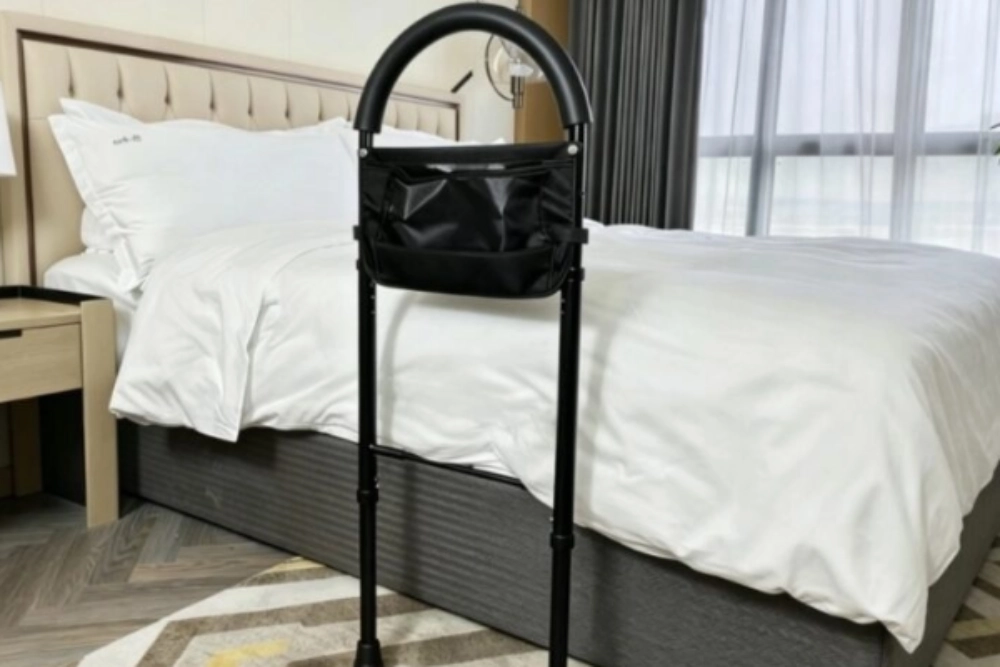
Bed Assist Rail Installation Why Mattress Fit and Frame Support Decide Stability

Key Takeaways

  • Check the bed frame and mattress together; mattress labels alone do not confirm compatibility.
  • The rail must resist sideways and upward movement during the real transfer motion.
  • Gaps around the mattress and rail require careful assessment to reduce entrapment risk.
  • Recheck straps, fasteners, feet, and mattress position after cleaning or moving the bed.

The Load Does Not Travel Straight Down

When a person rises from lying to sitting, the hand usually pulls diagonally. During standing, the hand may push downward and outward. These force directions create leverage at the rail connection. A long handle magnifies movement at a loose attachment point, so a small amount of play below the mattress can become noticeable at the grip.

Mattress Compression Changes the Effective Gap

A thick foam mattress can compress deeply under body weight. The rail may appear close to the unloaded mattress but form a larger space after the user lies beside it. A thin mattress can create a different problem if the handle position is too high relative to the sitting surface. Check the installation with the mattress loaded and with bedding in place, while following the product instructions and applicable safety guidance.

The bed assist rail with storage pocket uses a steel frame, adjustable height from 85 to 103 cm, a product footprint of 37 by 71 cm, a net weight of 4.0 kg, and a stated maximum load of 136 kg. Its handle, leg, and landing-bar dimensions can be adjusted. That range supports different bed setups, but the installer must still confirm that the landing structure is supported and that the handle remains correctly positioned beside the mattress.
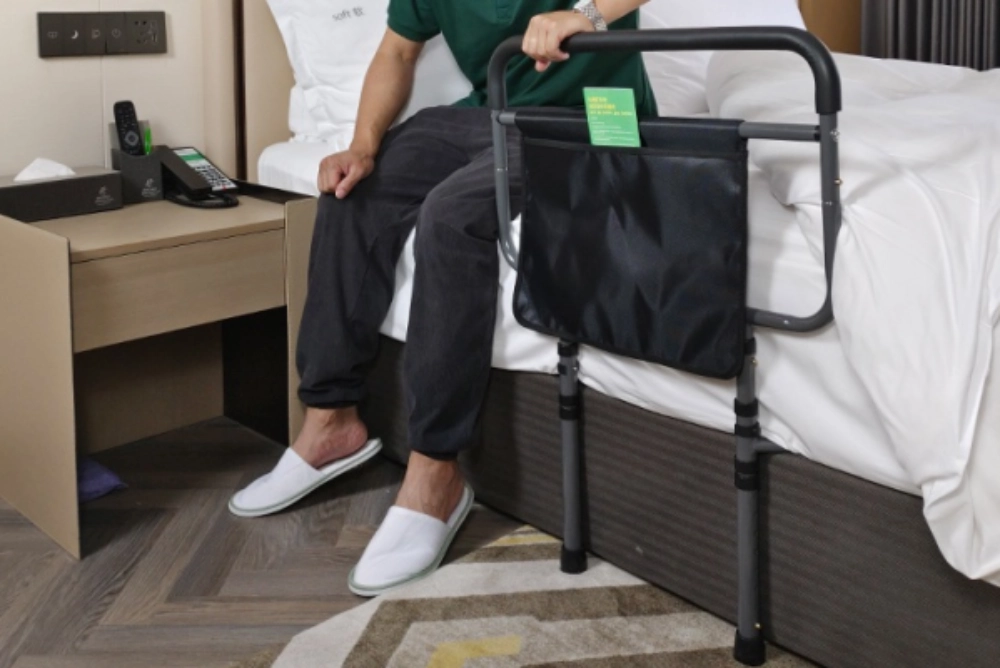
Bed Assist Rail with Storage Pocket

Match the Rail to the Bed Structure

Platform beds, box springs, slatted frames, hospital-style adjustable bases, and storage beds do not provide the same support. A rail that relies on a section beneath the mattress needs a firm, unobstructed bearing area. A legged design also needs stable floor contact. Deep carpet, an uneven floor, or a bed placed partly on a rug can change the leg height and create rocking.

Adjustable Beds Need a Separate Compatibility Review

When the head or foot section moves, the mattress and frame geometry changes. A rail can collide with the moving base, pinch bedding, or shift relative to the user. Do not install a generic bedside rail on an adjustable bed unless the rail instructions and bed manufacturer allow that configuration. Recheck all clearances through the full movement range.

Bed Condition Possible Failure Installation Check
Thick soft mattress Rail-to-mattress gap changes under load Test with mattress compressed
Slatted frame Landing bar sits over an unsupported gap Locate a continuous support area
Deep carpet Support leg sinks or tilts Confirm firm, level floor contact
Adjustable base Rail collides or moves relative to mattress Verify compatibility through full motion
Loose mattress topper Bedding shifts around the handle Secure bedding and reassess gaps

Position the Handle for the Actual Transfer

The best handle location depends on where the user rotates, lowers the legs, and places the feet. Too close to the headboard may force a long reach. Too far toward the foot can block leg movement or encourage pulling at an awkward angle. Observe the transfer rather than placing the rail by visual symmetry.

Keep the Floor and Bedside Route Clear

A stable handhold does not help if the standing foot lands on a loose mat, cable, or clutter. The floor beside the bed should be dry, level, and well lit. Shoes or nonslip footwear should be within reach when part of the care plan. Storage pockets should hold light essentials only and must not obstruct the handle or create a snag point.

The principles used when evaluating lightweight walking aids for seniors also apply beside the bed: fit, contact with the floor, hand position, and the user’s actual movement matter more than a broad product label. The transition from bed rail to walker should be planned so the person never has to reach across an unsupported gap.

Inspect the Rail After Installation and During Use

Apply force gradually in the directions expected during transfer. Look for movement at adjustment pins, straps, landing bars, leg feet, and frame joints. Stop if the bed frame flexes or the mattress shifts away from the handle. The first check should be supervised, and the user should not test full body weight on an unverified setup.

Repeat the inspection after the bed is moved, bedding is changed, the mattress is rotated, or the floor is cleaned. Fasteners and straps can loosen with repeated loading. Foam grips should remain dry and intact. A damaged grip can rotate or reduce friction even when the steel frame is sound.

For institutional or rental use, record the bed type and adjustment setting with each issued rail. A return inspection should check frame deformation, missing hardware, strap wear, grip damage, and whether the landing feet still sit evenly. Packaging also matters: a bent leg or crushed adjustment pin may not be obvious until the user loads the handle. A simple incoming checklist that includes unloaded and loaded stability catches these defects before deployment.

Beiqin supports OEM and ODM programs across bedside safety, bathroom aids, mobility products, and elderly-care equipment. For a bed-rail program, buyers should specify compatible bed constructions, adjustment range, load-test method, gap assessment, packaging protection, assembly instructions, and inspection points for every shipment. The bed-rail product range provides a useful comparison point for dimensions and configurations, and Beiqin’s contact channel can be used to confirm private-label or shipment requirements.

FAQ

Can a Bed Assist Rail Fit Every Mattress Size?

No. Mattress width alone does not confirm fit. Mattress thickness, compression, frame construction, support area, floor height, and adjustment range must all be checked.

Is a Bed Rail the Same as a Fall-Prevention Barrier?

No. A compact assist rail is mainly a handhold for repositioning and transfers. It may introduce entrapment or climbing risks for some users, so individual assessment is necessary.

How Tight Should the Rail Be?

Follow the product instructions and use the supplied attachment method. The rail should not move under the expected transfer forces, but over-tightening can damage components or the bed.

Can This Type of Rail Be Used on an Adjustable Bed?

Only when compatibility is confirmed for both products. Moving sections can change gaps or cause collision, so the full articulation range must be checked.

How Often Should a Bed Assist Rail Be Inspected?

Check it before use and after any change to the bed, mattress, bedding, or floor position. A periodic documented inspection is also useful in care facilities and rental programs.


Bed assist rail installation is stable only when the rail, mattress, bed frame, and floor support work together. A handle can feel firm during a light hand test yet shift when a person pulls upward and sideways while sitting up. Soft mattresses compress, adjustable bases move, slatted frames leave unsupported gaps, and storage beds may block the stabilizing legs. The correct product must fit the exact bed construction, not merely the nominal mattress size.

A bedside rail is a transfer aid, not automatically a fall-prevention barrier. Some users may become trapped between a rail and mattress, climb over it, or pull in a direction the installation was not designed to resist. A caregiver or qualified professional should assess the user’s mobility, cognition, nighttime behavior, mattress system, and transfer method before installation.


图片: Bed Assist Rail Installation Why Mattress Fit and Frame Support Decide Stability

Key Takeaways

  • Check the bed frame and mattress together; mattress labels alone do not confirm compatibility.
  • The rail must resist sideways and upward movement during the real transfer motion.
  • Gaps around the mattress and rail require careful assessment to reduce entrapment risk.
  • Recheck straps, fasteners, feet, and mattress position after cleaning or moving the bed.

The Load Does Not Travel Straight Down

When a person rises from lying to sitting, the hand usually pulls diagonally. During standing, the hand may push downward and outward. These force directions create leverage at the rail connection. A long handle magnifies movement at a loose attachment point, so a small amount of play below the mattress can become noticeable at the grip.

Mattress Compression Changes the Effective Gap

A thick foam mattress can compress deeply under body weight. The rail may appear close to the unloaded mattress but form a larger space after the user lies beside it. A thin mattress can create a different problem if the handle position is too high relative to the sitting surface. Check the installation with the mattress loaded and with bedding in place, while following the product instructions and applicable safety guidance.

The bed assist rail with storage pocket uses a steel frame, adjustable height from 85 to 103 cm, a product footprint of 37 by 71 cm, a net weight of 4.0 kg, and a stated maximum load of 136 kg. Its handle, leg, and landing-bar dimensions can be adjusted. That range supports different bed setups, but the installer must still confirm that the landing structure is supported and that the handle remains correctly positioned beside the mattress.


图片: Bed Assist Rail with Storage Pocket

Match the Rail to the Bed Structure

Platform beds, box springs, slatted frames, hospital-style adjustable bases, and storage beds do not provide the same support. A rail that relies on a section beneath the mattress needs a firm, unobstructed bearing area. A legged design also needs stable floor contact. Deep carpet, an uneven floor, or a bed placed partly on a rug can change the leg height and create rocking.

Adjustable Beds Need a Separate Compatibility Review

When the head or foot section moves, the mattress and frame geometry changes. A rail can collide with the moving base, pinch bedding, or shift relative to the user. Do not install a generic bedside rail on an adjustable bed unless the rail instructions and bed manufacturer allow that configuration. Recheck all clearances through the full movement range.

Bed Condition Possible Failure Installation Check
Thick soft mattress Rail-to-mattress gap changes under load Test with mattress compressed
Slatted frame Landing bar sits over an unsupported gap Locate a continuous support area
Deep carpet Support leg sinks or tilts Confirm firm, level floor contact
Adjustable base Rail collides or moves relative to mattress Verify compatibility through full motion
Loose mattress topper Bedding shifts around the handle Secure bedding and reassess gaps

Position the Handle for the Actual Transfer

The best handle location depends on where the user rotates, lowers the legs, and places the feet. Too close to the headboard may force a long reach. Too far toward the foot can block leg movement or encourage pulling at an awkward angle. Observe the transfer rather than placing the rail by visual symmetry.

Keep the Floor and Bedside Route Clear

A stable handhold does not help if the standing foot lands on a loose mat, cable, or clutter. The floor beside the bed should be dry, level, and well lit. Shoes or nonslip footwear should be within reach when part of the care plan. Storage pockets should hold light essentials only and must not obstruct the handle or create a snag point.

The principles used when evaluating lightweight walking aids for seniors also apply beside the bed: fit, contact with the floor, hand position, and the user’s actual movement matter more than a broad product label. The transition from bed rail to walker should be planned so the person never has to reach across an unsupported gap.

Inspect the Rail After Installation and During Use

Apply force gradually in the directions expected during transfer. Look for movement at adjustment pins, straps, landing bars, leg feet, and frame joints. Stop if the bed frame flexes or the mattress shifts away from the handle. The first check should be supervised, and the user should not test full body weight on an unverified setup.

Repeat the inspection after the bed is moved, bedding is changed, the mattress is rotated, or the floor is cleaned. Fasteners and straps can loosen with repeated loading. Foam grips should remain dry and intact. A damaged grip can rotate or reduce friction even when the steel frame is sound.

For institutional or rental use, record the bed type and adjustment setting with each issued rail. A return inspection should check frame deformation, missing hardware, strap wear, grip damage, and whether the landing feet still sit evenly. Packaging also matters: a bent leg or crushed adjustment pin may not be obvious until the user loads the handle. A simple incoming checklist that includes unloaded and loaded stability catches these defects before deployment.

Beiqin supports OEM and ODM programs across bedside safety, bathroom aids, mobility products, and elderly-care equipment. For a bed-rail program, buyers should specify compatible bed constructions, adjustment range, load-test method, gap assessment, packaging protection, assembly instructions, and inspection points for every shipment. The bed-rail product range provides a useful comparison point for dimensions and configurations, and Beiqin’s contact channel can be used to confirm private-label or shipment requirements.

FAQ

Can a Bed Assist Rail Fit Every Mattress Size?

No. Mattress width alone does not confirm fit. Mattress thickness, compression, frame construction, support area, floor height, and adjustment range must all be checked.

Is a Bed Rail the Same as a Fall-Prevention Barrier?

No. A compact assist rail is mainly a handhold for repositioning and transfers. It may introduce entrapment or climbing risks for some users, so individual assessment is necessary.

How Tight Should the Rail Be?

Follow the product instructions and use the supplied attachment method. The rail should not move under the expected transfer forces, but over-tightening can damage components or the bed.

Can This Type of Rail Be Used on an Adjustable Bed?

Only when compatibility is confirmed for both products. Moving sections can change gaps or cause collision, so the full articulation range must be checked.

How Often Should a Bed Assist Rail Be Inspected?

Check it before use and after any change to the bed, mattress, bedding, or floor position. A periodic documented inspection is also useful in care facilities and rental programs.

Share To:

Table of Contents

    related articles

    nw2
    Beiqin Carbon Fiber Electric Wheelchair Leads A New Travel Experience
    What Features Should Buyers Look for in Professional Rollator Walkers
    What Features Should Buyers Look for in Professional Rollator Walkers
    Full-Scenario Product Matrix Enriches Elderly Care Products Market
    Full-Scenario Product Matrix Enriches Elderly Care Products Market
    What Are the Secrets Behind Beiqin’s Senior-Centric Step Stool Design Philosophy
    What Are the Secrets Behind Beiqin’s Senior-Centric Step Stool Design Philosophy?
    Which Material Wins the Durability Test for Your Next Bulk Commode chair Order
    Which Material Wins the Durability Test for Your Next Bulk Commode chair Order?
    Which Key Material Specifications Define a High-Quality Knee Scooter for Long-Term Fleet Use
    Which Key Material Specifications Define a High-Quality Knee Scooter for Long-Term Fleet Use?

    Get In Touch With Us

    You can contact us any way that ls convenient for you.