The turning safety of a knee scooter depends on three factors that are easily misjudged: traveling speed, steering angle and the position of body weight. A four-wheel knee walker can feel stable enough when traveling in a straight line on a hard, smooth surface. But during a sharp turn, the center of mass will shift to the outside of the turn and can be threatened by a threshold, a loose rug edge, wet surfaces or a sudden braking action. Therefore, when turning, it is best to travel slowly, hold both handles and take a wide turn rather than trying to make a sharp turn and pivot.
A knee scooter is not for everyone and will not be suitable for every recovery. The user must be able to put weight through the knee that is being supported, operate the handlebar and brakes, balance on the other leg and follow appropriate mobility as recommended by healthcare professionals. Some individuals may require assessment by a clinician or qualified healthcare professional to determine suitability where, for example, there is injury/surgery, weakness, poor balance or the user is taking certain medications.
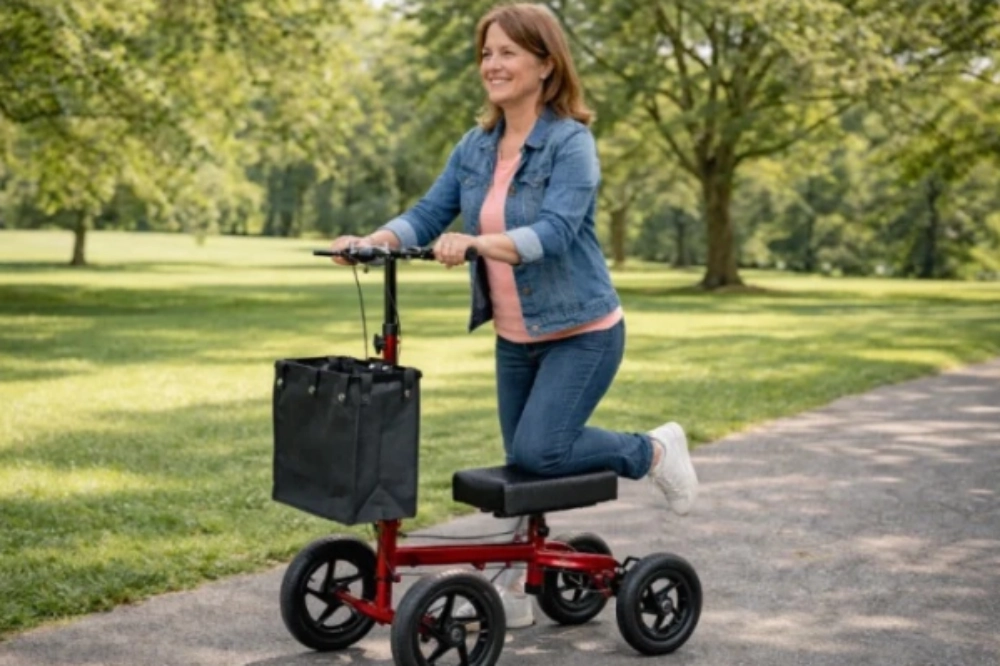
Scooter and user are moving forward with momentum. Wheel forces are changed by steering. However, the body of the user wants to continue on the initial direction of travel. The more the scooter is moving the tighter the turn is made, the more sideways forces are placed on the tires, and the greater the outward movement of the body of the user. If the inside wheels are unloaded too far, the stability of the scooter drops.
The four tire contact points create a support polygon. A longer wheelbase helps straight-line stability, while track width gives lateral support. Neither dimension makes sharp cornering risk-free. The user’s torso, basket contents, knee position, and steering input all change where the combined center of mass sits relative to that polygon.
The Medical Knee Walker Scooter for Broken Foot and Ankle Surgery uses a steel frame with an overall size of 88 by 43 cm and an adjustable handle height from 89.5 to 113.5 cm. It has dual brakes, a folding structure, nine handle-height positions, six knee-pad adjustment positions, a net weight of 10.4 kg, and a stated maximum user weight of 136 kg. These specifications help define fit and handling, but they do not replace a controlled trial in the actual environment.
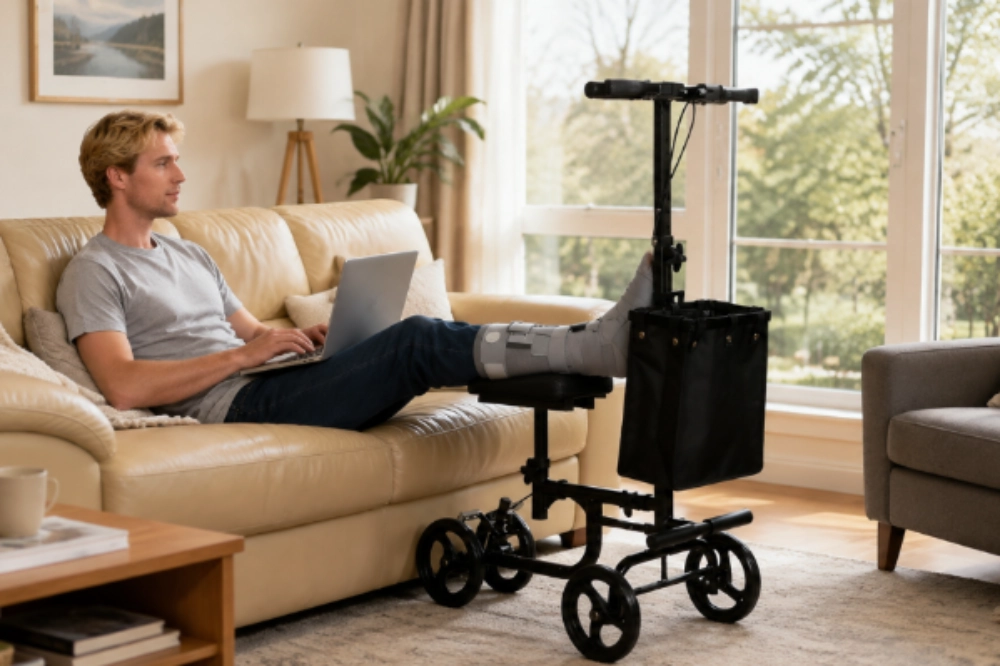
The handlebar should be reachable without rounding the shoulders or leaning heavily forward. The supported knee needs a stable position on the pad, while the standing leg should have room to push without striking the frame. If the handle is too low, body weight moves forward and steering may become abrupt. If it is too high, the shoulders rise and braking control can become awkward.
Brake response should be checked on a dry, level surface at walking speed. The user needs to know how much hand force produces a gradual stop and whether both sides respond consistently. A brake is not a substitute for reducing speed before a slope or corner. Parking brakes, where fitted, should be engaged before mounting, dismounting, or adjusting the knee pad.
| Environment | Main Handling Risk | Safer Check |
| Narrow doorway | Front wheel clips the frame during a turn | Approach straight and confirm clear width |
| Loose rug edge | Wheel catches while steering is angled | Remove or secure the rug before use |
| Wet bathroom tile | Reduced tire grip and sudden slide | Keep the route dry and use another aid if needed |
| Sloped driveway | Speed rises faster than expected | Avoid the route unless professionally assessed |
| Crowded room | Sudden direction changes | Clear a wider path before moving |
A wheel meeting a threshold straight on can often roll over it more predictably than a wheel striking at an angle. During a turn, one front wheel may contact the obstacle first while the user’s weight is already moving sideways. The handlebar can rotate suddenly, and the standing foot may not be in a good position to recover. Floor transitions, elevator gaps, cords, and uneven paving should be checked before regular use.
A storage bag is useful because it keeps the user’s hands on the handlebar. It should not be overloaded or used for heavy objects that swing during a turn. Items must not obstruct the brake cables or steering column. Never hang a heavy bag from one side of the handlebar; asymmetric weight makes low-speed control less predictable.
A previous comparison of knee scooters and crutches in rehabilitation settings can help frame the use boundary: each aid demands a different combination of balance, upper-body control, space, and surface quality. Selection should follow the user and setting rather than a broad claim that one product is always safer.
Before each use, confirm that the folding joint is locked, handle and knee-pad adjustment pins are fully engaged, brakes respond evenly, tires rotate freely, and no fastener is loose. Look for damage around the front fork and steering column. Keep the knee pad clean and dry so the supported leg does not slide.
During the first trial, use a caregiver or professional nearby where appropriate. Practice starting, gradual stopping, broad turns, reversing a short distance, and getting on and off with the brakes applied. Do not begin on a crowded pavement or a route with slopes. The goal is controlled movement, not maximum speed.
For a distributor, the same checks should appear in the receiving and user-instruction process. Confirm that the carton protects the brake levers and steering column, that height-adjustment markings remain readable, and that the folded unit can be secured without pressure on the cables. A sample inspection should record frame welds, wheel alignment, brake response, adjustment-pin engagement, and the maximum load statement. These details reduce avoidable returns much more effectively than a generic claim about stability.
Beiqin manufactures rehabilitation and elderly-care aids, including knee scooters, walkers, rollators, bathroom safety equipment, and bedside support products. For distributors, the useful product review includes adjustment range, brake function, folding durability, carton protection, inspection criteria, replacement parts, and clear user instructions, not appearance alone. The knee scooter product category can be reviewed alongside the selected model when building a product range, while the contact team can handle configuration and packaging questions.
Wet floors reduce tire grip and increase stopping distance. Avoid wet or slippery routes. If bathroom access is necessary, use an aid and care plan assessed for that environment.
Tight steering shifts the combined center of mass toward the outside wheels. Speed, body lean, wheelbase, track width, and surface grip all affect the remaining stability margin.
Follow the product instructions. Even braking generally supports a straighter stop, while one-sided or abrupt input may change direction. Brake function should be tested before regular use.
The height should allow the supported leg to rest without twisting the pelvis or forcing the standing leg into an awkward posture. A clinician or qualified caregiver should confirm fit when recovery restrictions apply.
No. Do not ride a knee scooter on stairs or escalators. Arrange an accessible route or use another transfer method recommended by a professional.