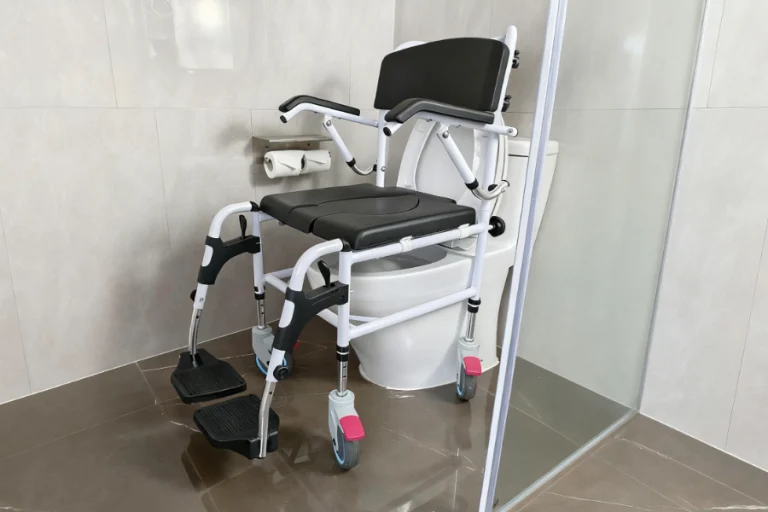
Raised toilet seat height has a direct effect on the amount of effort required to complete a bathroom transfer of an older adult and the amount of balance required to safely complete the transfer. A raised toilet seat that is too low causes increased knee and hip flexion which makes standing up from the toilet more difficult. A raised toilet seat that is too high can cause the user to lose their balance or have difficulty completing a safe and controlled sit down. The only reliable way to determine the correct height for a raised toilet seat is to take the lower-leg measurement of the user and then test out the raised toilet seat on the floor of the bathroom where it will be used with the user wearing the same type of footwear that they will be wearing when they use the raised toilet seat. Importers and care facilities must also take into consideration several other specifications when choosing a raised toilet seat such as arm support, attachment, open, clean, package etc. In order to ensure that the raised toilet seat chosen will safely meet the needs of the user and last throughout the day with repeated use.
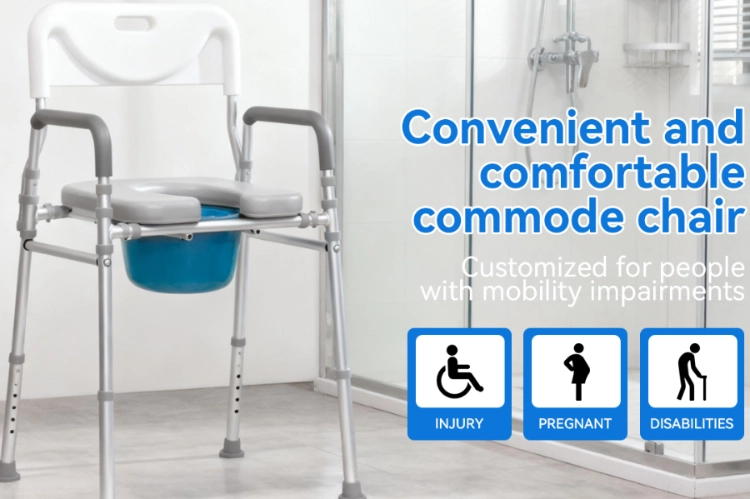
Standing from a toilet is a coordinated activity of the hips, knees, ankles and trunk. As the toilet seat descends, the depth of the squat increases and therefore more range needs to be produced by the hips, knees and ankles. This increased range may exceed the individual’s strength or the available joint range. Raising the toilet seat increases the vertical height between the floor and the seat thus reducing the depth of the squat required. However, if the seat is raised too high, there is a danger that there will be no foot contact with the floor to provide a brake during the lowering phase. Therefore, the objective is to set the toilet seat at a height that enables an individual to sit down and rise to stand, controling their movements with their feet planted on the floor.
A practical starting posture has the user seated with both soles fully supported, knees close to a right angle, and hips level with or slightly higher than the knees. Arm supports should be reachable without a sharp forward lean. These are reference conditions rather than a medical prescription. When balance is poor, trunk control is limited, or recovery from surgery affects weight bearing, a therapist or experienced caregiver should assess the transfer before a product is selected.
Measure the user on a firm, level surface while wearing the shoes or shower-safe footwear normally used in the bathroom. Record the vertical distance from the floor to the crease behind the knee. Compare that value with the existing toilet height plus the proposed riser. Include the thickness of the seat pad, if present, because soft foam compresses under load and can reduce the effective height after several minutes of sitting.
Repeat the check in the installation location. A thick bath mat, a raised tile transition, or a toilet positioned close to a wall can change the way the feet and elbows line up. Leave enough lateral clearance for the user to approach, turn, and lower down without striking the armrests against cabinets. For facilities, record a minimum and maximum user measurement so the order can be divided into appropriate height groups instead of forcing one nominal size onto every resident.
Armrests provide a defined surface for a downward push when the frame is correctly secured. They are not a substitute for a wall-mounted grab bar and should not be treated as a handle for forceful sideways pulling. Check the armrest spacing against the user’s hip width and the bathroom layout. Flip-up or removable arms can improve caregiver access, but the hinge must lock positively and remain free of looseness after repeated cycles.
A centered opening supports hygiene while preserving contact under the thighs.
The riser must transfer load through the toilet bowl and its fixing points without rocking. Before service, tighten the supplied hardware evenly, check that the seat is centered, and apply a firm downward and lateral hand test. A unit that shifts when unloaded may move farther when the user twists to reach toilet paper or a flush control. Ask the manufacturer for the rated load, test method, and hardware options for different bowl shapes instead of relying on a generic universal claim.
| User condition | Height or fit check | Risk when mismatched |
| Feet flat, knees near 90 degrees | Preferred starting position | Balanced weight shift |
| Seat lower than knee crease | Requires deeper bend and forward lean | Harder standing |
| Seat higher than knee crease | Check full sole contact | Unstable descent |
| Thick mat beneath riser | Measure from mat surface | Rocking or altered height |
| Armrests near cabinet | Test approach and turning space | Restricted caregiver access |
| Soft cushion added later | Recheck compressed height | Fit changes during use |
A riser may solve the initial stand but create a new problem at the bathroom doorway or shower threshold. Walk through approach, turning, sitting, wiping, flushing, and standing again. The user should be able to place the hands where intended at every stage, with no need to reach behind the body or twist around a fixed arm.
Oval and elongated bowls do not always accept the same clamp position. Inspect the underside for clearance, then retighten after the first few uses because plastic components can settle. For an export order, request a dimensional drawing, fitting photographs, spare hardware, and an installation sheet in the destination language.
Cracked armrests, bent brackets, and missing knobs are functional failures, not minor carton damage. Sample cartons should be drop-checked according to the buyer’s logistics route, and every production batch should be checked for hardware count, label accuracy, and readable load-rating marks. Keep one opened carton from each shipment for traceability.
Yongkang Beiqin Industry And Trade Co., Ltd. manufactures bathroom safety and rehabilitation aids from its Yongkang, Zhejiang base. Its 20,000-square-meter manufacturing operation supports OEM, ODM, and OBM programs, with documented production, packaging, and inspection coordination for distributors and care-product brands. Buyers can use the raised toilet seat product page as the starting point for matching seat geometry, handles, and customization requirements.
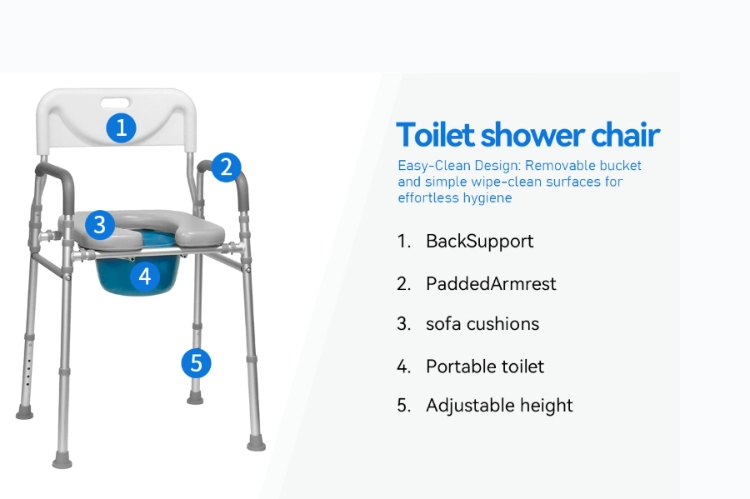
Before approving a larger purchase, compare at least two samples under the same toilet, mat, footwear, and cleaning routine. Repeat the transfer several times, measure any movement at the clamps, and photograph the underside after installation. A related commode chair safety checklist can help teams document load, hardware, drainage, and hygiene checks when bathroom and bedside products are evaluated together.
Use the height that allows full foot contact, knees near 90 degrees, and hips level with or slightly above the knees. Measure the user and confirm the position on the installed toilet; a fixed number cannot fit every leg length or bathroom layout.
No. A riser changes the sitting height, while a grab bar provides an independent, fixed handhold. Users who pull strongly to one side, or who cannot control the descent, need a broader transfer assessment and possibly additional equipment.
Inspect it at installation, after the first several uses, and during each routine cleaning for rocking, loose clamps, cracks, damaged pads, and unreadable labels. Shared-care facilities should log these checks and remove any unit that shifts under a firm hand test.