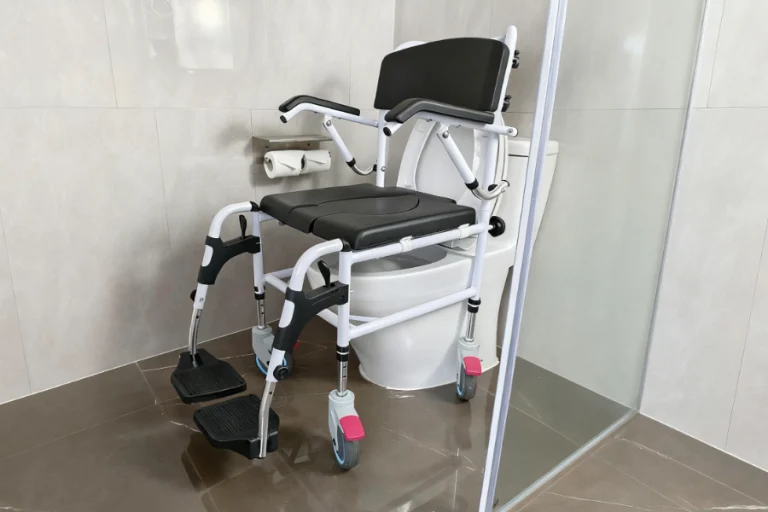
Seat height changes the way an older adult approaches every part of a shower transfer. Seats that sit too low for the knees and hips will make it more difficult to stand up. On the other hand, seats that are too high up will mean that the feet do not touch the floor firmly enough. The best height is when a person can sit with both feet planted on the floor in front of them. They should be able to keep their trunk straight and stand up from the seat without grabbing onto bathroom features like taps, towel rails, etc.
Look for a chair that fits the user better than it looks. For an older adult, a person with a disability, or someone rebuilding mobility after injury, fit to use safely is more important than appearance. Start with the transfer height to the seat, then check the slope down from the seat, the clearance under the legs for the user’s feet, and the height of the armrests against the user’s ability to reach and hold them comfortably while sitting in the chair. Also consider the chair’s drainage and ease of cleaning on a daily basis – these are key factors in your safety decision, don’t leave them until later.
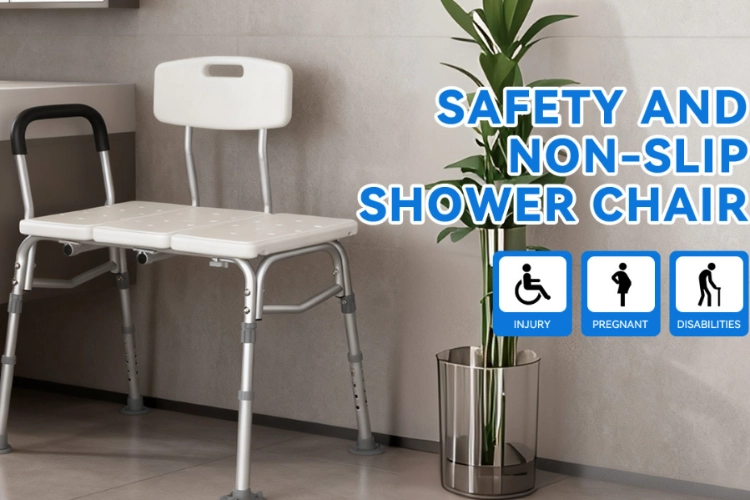
During a transfer, the chair takes over part of the load that would otherwise remain on the legs. The person backs toward the seat, lowers the body while using the feet and armrests for support, and settles the trunk once seated. When the seat does not suit the person’s leg length, that short sequence can become awkward and difficult to control.
A well-fitted sitting position usually has these signs:
There is no single height that works for everyone. Two people of similar overall height may have different lower-leg lengths or very different strength. Footwear, the condition of the bathroom floor, and whether a caregiver assists with the transfer can all shift the best setting.
Where balance is poor, weakness is pronounced, movement is unpredictable, or surgery was recent, the chair should not be selected by measurement alone. A therapist or experienced caregiver can assess the transfer and decide whether extra support or another type of bathing aid is needed.
One straightforward measurement can narrow the suitable range before ordering.
Have the user sit on a firm, level surface and place both feet flat. Measure vertically from the floor to the crease at the back of the knee. Use that figure as a starting point for the shower seat, then fine-tune the legs until foot contact, comfort, and control during standing all feel secure.
| User Position or Condition | Height Consideration | Possible Problem if Incorrect |
| Feet flat, knees near 90 degrees | Usually the preferred starting position | Better weight distribution |
| Seat much lower than the knee crease | Requires deeper knee and hip bending | Difficult standing and greater forward lean |
| Seat much higher than the knee crease | Feet may not sit firmly on the floor | Reduced stability during transfer |
| Thick bath mat under the chair | Reduces effective seat height and stability | Chair movement or uneven footing |
| Sloped shower floor | Changes the height from front to back | Chair tilt and uneven leg loading |
| User wearing shower shoes | Adds a small amount of foot height | May alter knee angle and reach |
Always repeat the check where the chair will actually be used. A setting that seems right in a dry room can feel quite different once the chair is on a sloped shower floor, a damp surface, or inside a bath.
Seat height is only one part of the fit. The frame, seat, arm supports, and floor contacts have to remain stable through the whole routine: approaching the chair, sitting, turning, bathing, and standing again.
Depth and width are easy to overlook. On an overly deep seat, a shorter person may slide forward just to place the feet properly; too little depth leaves the thighs poorly supported. Width should allow a relaxed posture without leaving so much spare space that the body shifts from side to side.
Facilities buying for several users should record the range of body sizes and transfer abilities they need to accommodate. One nominal size rarely fits every resident or patient, so the order may need two or more chair configurations.
Armrests give the user a defined place to push from, provided there is enough upper-body strength to use them safely. The backrest can steady the trunk during bathing. It should still allow an upright position, however; leaning too far back may lighten or lift the feet and reduce control.
Check the armrest height while the user is seated, using the elbows and shoulders as a guide. High supports tend to shrug the shoulders and make the push awkward. Low ones can draw the torso too far forward before the person is ready to stand.
Water pooling on a bath seat increases cleaning work and leaves the user sitting on a wet surface. The Height Adjustable Shower Bench with Backrest includes drainage holes designed to allow water to leave the seat surface. Its lightweight aluminum frame supports loads up to 300 lb.
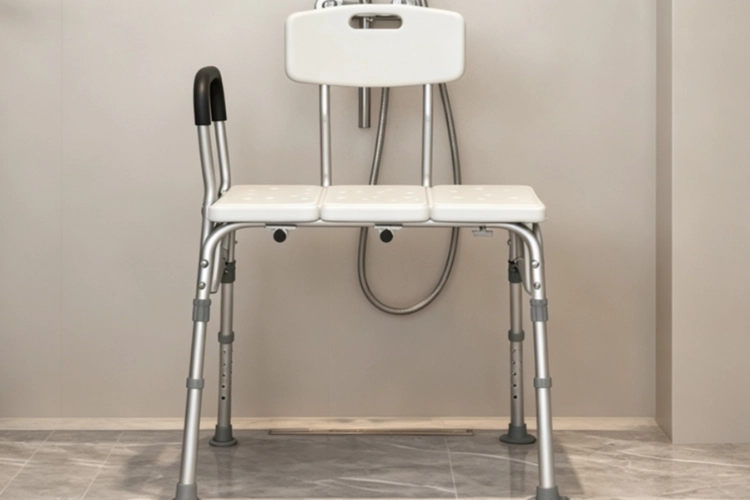
Drainage holes only help when water can pass through them. Hair, soap film, and mineral scale build up gradually, so a blockage may not be obvious at first. In a care setting, staff can check the openings while cleaning the seat instead of relying on a visual glance from a distance.
All legs should meet the floor firmly, without rocking. Inspect rubber tips and other non-slip parts at regular intervals; wear, hardened rubber, soap, or dirt can noticeably reduce their grip on a wet surface.
Avoid setting the chair on a loose bath mat unless the manufacturer specifically approves that combination. During a transfer, the mat may creep, bunch beneath one leg, or alter the angle of the entire frame.
A shower chair can reduce effort, but it is not the right answer in every bathroom or for every user.
Another solution may be needed when:
Adjustable legs can correct a modest height mismatch; they cannot compensate for a cramped layout or a transfer that is fundamentally unstable. Depending on the problem, a transfer bench, commode shower chair, wall-mounted grab bar, or hands-on caregiver support may be the safer choice.
A sloped floor sometimes calls for different settings from one leg to another. Make those changes cautiously: once adjusted, press on the seat from several directions and confirm that it neither rocks nor leaves a foot partly unsupported.
Measure from the surface the user’s feet will actually stand on. A thick non-slip mat, a raised drain cover, or the base of a bathtub can all change the effective height enough to affect knee position.
Chair-mounted armrests travel with the frame, unlike a grab bar fixed to the wall. They should therefore be used mainly for a controlled downward push, not as a point for forceful sideways pulling unless the chair is rated for it.
Cleaning chemicals that are harmless to tile may discolor plastics or attack other chair surfaces over time. Follow the chair’s care instructions, rinse off the cleaner, and dry around connections when practical. Joints, leg-adjustment holes, and fasteners deserve particular attention because moisture can linger there.
Before a batch of chairs goes into service, check every unit for:
Yongkang Beiqin Industry And Trade Co., Ltd. supports OEM, ODM, and OBM programs for elderly care and rehabilitation aids. The company operates from Yongkang, Zhejiang, with a 20,000-square-meter manufacturing base, four production lines, and product categories that include shower chairs, rollators, walkers, commode chairs, bed rails, wheelchairs, and other mobility aids. For broader product evaluation, Beiqin’s elderly care product range can be matched to different bathroom layouts and user-support requirements.
Before approving a larger purchase, compare several samples under the same conditions. Adjust each chair more than once, repeat typical transfers, clean the seat, and note any damage from shipping. It is also worth measuring whether identical height settings produce consistent results across the samples. Those observations reveal far more than a catalog image.
A shower bench sourcing checklist can help organize these checks around dimensions, materials, production consistency, packaging, and after-sales documentation. Company background and manufacturing information can be reviewed through Beiqin’s manufacturer profile when a long-term product program is being considered.
Aim for full foot contact with the knees at roughly 90 degrees and the hips level with, or a little above, the knees. The floor-to-knee-crease measurement gives a starting point, but the final setting should be tested in the bathroom with the user’s usual shower footwear.
Yes. They let water leave the sitting surface instead of collecting beneath the user. They are not maintenance-free, though: hair, soap film, and mineral scale can gradually close the openings, so routine cleaning still matters.
No. The bench supports the body in a seated position; a fixed grab bar provides an independent handhold while the person turns or transfers. Anyone who relies on strong pulling or sideways support may need a professionally positioned grab bar as well as the chair.