Consider a returned rollator with a soft left lever. On the bench, its left rear wheel turns even after the parking action is set. The next question is why. From the grip alone, a loose cable, damaged wheel and half-engaged catch can feel remarkably alike.
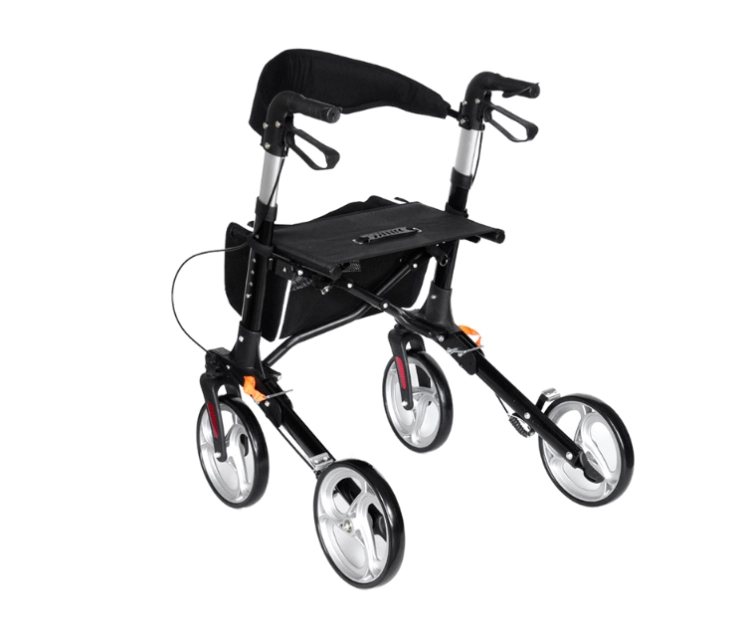
The Beiqin 1002F has linear pull brakes and 8-inch wheels front and rear. That narrows the parts search. It does not clear this pair of brakes for use. Leave the person off the frame while investigating the fault.
Check first: Both rear wheels must stop under braking and release freely.

Start at the label on the frame. Two rollators can share a seat shape and a 136 kg maximum while using different components. Send a parts desk photographs of both brake assemblies and the cable route through the folding joint. “Blue walker brake” is not enough to identify a replacement.
The 1002F model has an aluminum frame, a Textilene seat and PVC armrests. Its under-seat bag is easy to see; a cable tucked behind it may not be. Open the frame, look below the seat, then fold and reopen it while watching both cables. A sharp bend or a point of contact at the hinge calls for attention before anybody changes tension.
For identification, the exterior measures 56 cm long by 70 cm wide, with the handles listed at 86–98 cm. The frame is 9.0 kg net. Packed for shipment, it is 10.4 kg gross in a 41 × 29 × 69.5 cm carton, one unit per box. The 136 kg figure is its stated maximum load. It belongs on the inspection record, alongside the actual handle setting, but it does not certify a worn brake.
The 1002B looks similar but measures 54 × 67 × 83–96 cm and weighs 8.2 kg net. Its box is 42 × 23 × 68.5 cm at 10.0 kg gross. Both models state a 136 kg maximum. A 1002F is 2 cm longer and 3 cm wider, and its handle range sits 3 cm higher at either end. Its 9.0 kg net weight is 0.8 kg above 1002B, while the packed difference is 0.4 kg. The 1002F carton is 1 cm shorter, 6 cm wider and 1 cm taller than the 1002B carton. Those measurements can expose a wrong model at receiving; an unlabelled photo cannot establish the right cable or wheel.
Ask separately what happens when the walking brake is pulled and, if the delivered 1002F instructions specify a parking lock, what happens when that lock is set. Confirm the operating sequence on the actual build before testing it. Does each rear wheel resist rotation? Does it roll freely again when released? For any parking check, watch the wheels rather than the hand lever. A lever may reach its stop while a wheel still moves.
The NHS Supply Chain rollator reuse sheet checks wheel rotation, condition, frame, fixings and height knobs as well as pull-up and push-down brake actions. It is a useful pattern for a receiving bench. The 1002F’s actual lever sequence should still be confirmed from the instructions supplied for its build; the NHS sheet is not a Beiqin approval.
Set the opened 1002F on a level patch of floor. Make sure the handle locks are seated at equal heights and that no bag strap crosses a brake cable. Nobody should sit on the rollator during this check. There is enough to learn from the wheels without using a person as a test load.
With the lever released, spin one rear wheel by hand. It should not scrape against a brake part. Pull that side’s lever and watch the contact point. If this build has the specified parking lock, set it and see whether the wheel can still turn. Release it again. Repeat the sequence on the other side. If the left wheel moves in parking mode and the right stays put, write exactly that. “Weak brakes” does not tell a technician which side or which action failed.
The 1002F has 8-inch wheels at both ends. Check their rotation, visible wear and fasteners before reaching for a cable adjuster. Grit caught at a wheel or a loose mount will not be cured by shortening the cable. Look at the aluminum frame and the handle locks too. The NHS reuse sheet includes those checks for good reason: they can expose a fault that looks like a brake problem from the grips.
Now close and reopen the folding frame. Run the wheel check again. A change after folding points toward routing, interference or a disturbed fitting. It does not establish how many turns an adjuster needs. The under-seat bag, Textilene seat and PVC armrests should all be clear of the operating cable at the 1002F’s tested handle setting within its 86–98 cm range.
A short sequence record works: released; walking brake pulled; and, where fitted, parking lock set and released. Give each rear wheel a result at each stage. Add a photograph if a cable is frayed, a housing is cracked or a wheel drags. A note about the exact action makes a later comparison possible. “It seemed better” does not.
Do not use a slope as a brake test. If a unit moves under the stationary parking check, take it out of use. A real walking and sitting assessment belongs after the mechanical fault has been resolved, with the intended person and an appropriate professional.
An intact cable with excessive free lever travel may be an adjustment job. A cable that is frayed or trapped at the hinge is a replacement or repair job. A rear wheel that wobbles, or a frame that does not lock open, is another problem again. The adjustment screw cannot repair a wheel bearing, hinge or missing fitting.
| Observation on the 1002F | Decision for the service record |
| One lever has more free travel, but cable and brake parts appear intact | Use the current instructions to assess adjustment, then retest both sides |
| Cable strands show, or a housing catches when the frame folds | Stop use and identify the specified repair part |
| Wheel drags with the lever released | Investigate contact and wheel condition before tightening anything |
| Rear wheel turns with the confirmed parking lock set | Stop use; repair and repeat the stationary hold check |
| Model code or brake assembly is unclear | Confirm the 1002F revision before ordering a spare |
The 1002F uses a linear pull brake, but its correct adjuster direction, torque and turn count depend on the delivered assembly. If that information is missing, request the correct drawing through Beiqin service and support and let a qualified technician compare it with the physical brake. Turning a visible nut because another rollator has a similar lever can create drag without securing the parking brake.
After authorised work, repeat the stationary sequence. Both rear wheels must respond in the expected walking mode and any confirmed parking mode, then release without drag. Record what changed, who checked it and which manual revision was used. A later inspection should begin from the actual service history, not from an unexplained “fixed” sticker.
A parts request should carry the 1002F label, photographs of both rear brakes, the cable route with the frame open and folded, and the failed stage of the test. Add the 8-inch wheel specification, but ask for the exact wheel and cable codes rather than assuming that any 8-inch rollator wheel will fit. The older rollator brake feature guide helps buyers compare features at quotation stage. This record is about the unit that arrived.
For a fleet, mark pass only when the released wheels run freely and both brakes perform their supplied functions. Mark fail for a damaged part or a parking action that does not hold. Mark refer when the current instructions or part identity cannot be established; a referred unit stays out of use until the uncertainty is resolved. Send the label, photographs and sequence through the Beiqin contact page for the current 1002F brake information. The useful outcome is a working, documented assembly, not merely a tighter lever.
Consider a returned rollator with a soft left lever. On the bench, its left rear wheel turns even after the parking action is set. The next question is why. From the grip alone, a loose cable, damaged wheel and half-engaged catch can feel remarkably alike.
The Beiqin 1002F has linear pull brakes and 8-inch wheels front and rear. That narrows the parts search. It does not clear this pair of brakes for use. Leave the person off the frame while investigating the fault.
Check first: Both rear wheels must stop under braking and release freely.
Start at the label on the frame. Two rollators can share a seat shape and a 136 kg maximum while using different components. Send a parts desk photographs of both brake assemblies and the cable route through the folding joint. “Blue walker brake” is not enough to identify a replacement.
The 1002F model has an aluminum frame, a Textilene seat and PVC armrests. Its under-seat bag is easy to see; a cable tucked behind it may not be. Open the frame, look below the seat, then fold and reopen it while watching both cables. A sharp bend or a point of contact at the hinge calls for attention before anybody changes tension.
For identification, the exterior measures 56 cm long by 70 cm wide, with the handles listed at 86–98 cm. The frame is 9.0 kg net. Packed for shipment, it is 10.4 kg gross in a 41 × 29 × 69.5 cm carton, one unit per box. The 136 kg figure is its stated maximum load. It belongs on the inspection record, alongside the actual handle setting, but it does not certify a worn brake.
The 1002B looks similar but measures 54 × 67 × 83–96 cm and weighs 8.2 kg net. Its box is 42 × 23 × 68.5 cm at 10.0 kg gross. Both models state a 136 kg maximum. A 1002F is 2 cm longer and 3 cm wider, and its handle range sits 3 cm higher at either end. Its 9.0 kg net weight is 0.8 kg above 1002B, while the packed difference is 0.4 kg. The 1002F carton is 1 cm shorter, 6 cm wider and 1 cm taller than the 1002B carton. Those measurements can expose a wrong model at receiving; an unlabelled photo cannot establish the right cable or wheel.
Ask separately what happens when the walking brake is pulled and, if the delivered 1002F instructions specify a parking lock, what happens when that lock is set. Confirm the operating sequence on the actual build before testing it. Does each rear wheel resist rotation? Does it roll freely again when released? For any parking check, watch the wheels rather than the hand lever. A lever may reach its stop while a wheel still moves.
The NHS Supply Chain rollator reuse sheet checks wheel rotation, condition, frame, fixings and height knobs as well as pull-up and push-down brake actions. It is a useful pattern for a receiving bench. The 1002F’s actual lever sequence should still be confirmed from the instructions supplied for its build; the NHS sheet is not a Beiqin approval.
Set the opened 1002F on a level patch of floor. Make sure the handle locks are seated at equal heights and that no bag strap crosses a brake cable. Nobody should sit on the rollator during this check. There is enough to learn from the wheels without using a person as a test load.
With the lever released, spin one rear wheel by hand. It should not scrape against a brake part. Pull that side’s lever and watch the contact point. If this build has the specified parking lock, set it and see whether the wheel can still turn. Release it again. Repeat the sequence on the other side. If the left wheel moves in parking mode and the right stays put, write exactly that. “Weak brakes” does not tell a technician which side or which action failed.
The 1002F has 8-inch wheels at both ends. Check their rotation, visible wear and fasteners before reaching for a cable adjuster. Grit caught at a wheel or a loose mount will not be cured by shortening the cable. Look at the aluminum frame and the handle locks too. The NHS reuse sheet includes those checks for good reason: they can expose a fault that looks like a brake problem from the grips.
Now close and reopen the folding frame. Run the wheel check again. A change after folding points toward routing, interference or a disturbed fitting. It does not establish how many turns an adjuster needs. The under-seat bag, Textilene seat and PVC armrests should all be clear of the operating cable at the 1002F’s tested handle setting within its 86–98 cm range.
A short sequence record works: released; walking brake pulled; and, where fitted, parking lock set and released. Give each rear wheel a result at each stage. Add a photograph if a cable is frayed, a housing is cracked or a wheel drags. A note about the exact action makes a later comparison possible. “It seemed better” does not.
Do not use a slope as a brake test. If a unit moves under the stationary parking check, take it out of use. A real walking and sitting assessment belongs after the mechanical fault has been resolved, with the intended person and an appropriate professional.
An intact cable with excessive free lever travel may be an adjustment job. A cable that is frayed or trapped at the hinge is a replacement or repair job. A rear wheel that wobbles, or a frame that does not lock open, is another problem again. The adjustment screw cannot repair a wheel bearing, hinge or missing fitting.
| Observation on the 1002F | Decision for the service record |
|---|---|
| One lever has more free travel, but cable and brake parts appear intact | Use the current instructions to assess adjustment, then retest both sides |
| Cable strands show, or a housing catches when the frame folds | Stop use and identify the specified repair part |
| Wheel drags with the lever released | Investigate contact and wheel condition before tightening anything |
| Rear wheel turns with the confirmed parking lock set | Stop use; repair and repeat the stationary hold check |
| Model code or brake assembly is unclear | Confirm the 1002F revision before ordering a spare |
The 1002F uses a linear pull brake, but its correct adjuster direction, torque and turn count depend on the delivered assembly. If that information is missing, request the correct drawing through Beiqin service and support and let a qualified technician compare it with the physical brake. Turning a visible nut because another rollator has a similar lever can create drag without securing the parking brake.
After authorised work, repeat the stationary sequence. Both rear wheels must respond in the expected walking mode and any confirmed parking mode, then release without drag. Record what changed, who checked it and which manual revision was used. A later inspection should begin from the actual service history, not from an unexplained “fixed” sticker.
A parts request should carry the 1002F label, photographs of both rear brakes, the cable route with the frame open and folded, and the failed stage of the test. Add the 8-inch wheel specification, but ask for the exact wheel and cable codes rather than assuming that any 8-inch rollator wheel will fit. The older rollator brake feature guide helps buyers compare features at quotation stage. This record is about the unit that arrived.
For a fleet, mark pass only when the released wheels run freely and both brakes perform their supplied functions. Mark fail for a damaged part or a parking action that does not hold. Mark refer when the current instructions or part identity cannot be established; a referred unit stays out of use until the uncertainty is resolved. Send the label, photographs and sequence through the Beiqin contact page for the current 1002F brake information. The useful outcome is a working, documented assembly, not merely a tighter lever.