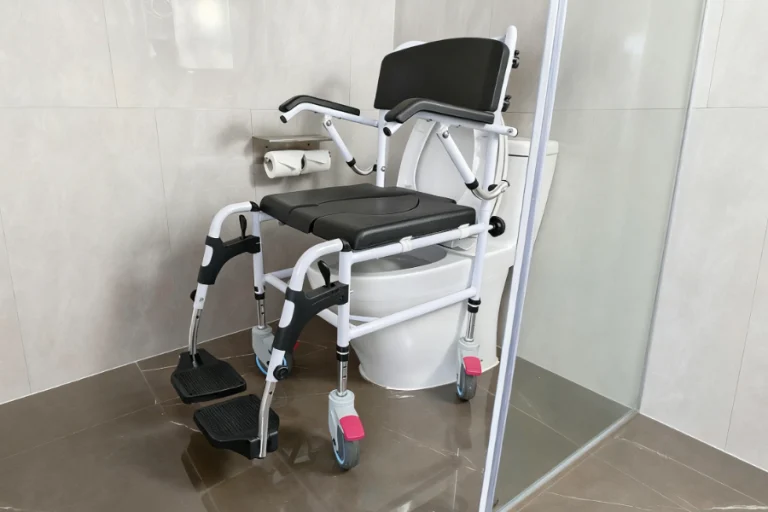
Bedside commodes are often thought of in relation to allowing people who find it difficult to reach a conventional toilet for personal reasons to use a portable alternative. Many such products have similar components to a toilet such as a seat, frame and a removeable toilet pot but there are significant differences in the construction and the recommended use of models on the market. Looking at a picture or reading a short description of a product does not give full information about it.
Description of features of a chair such as frame materials, seat, mechanisms for height adjustment and accessories supplied, in order to distinguish between features which can be seen and features which are claimed and which must be proved by test reports and other evidence. How to read a product specification in detail in order to be able to describe a product accurately.
Key considerations

Recording the relevant Model Number, Product Configuration and Document Revision Number within the Specification helps to ensure that details relating to Product Images, Product Catalogues and Instructional Documents have been developed at the relevant time. If there are conflicting details within two or more documents then these need to be clarified, rather than the conflicting details from the various documents being merged together and described within a single document. Subsequent comparison of differing documents will be so much easier if both documents are referred to on the basis of the latest relevant document revision.
Core entries include the stated functions, frame material, overall dimensions, seat dimensions where provided, rated user capacity, height-adjustment range, supplied components and assembly requirements. The presence of a container, backrest, armrest, footrest or wheels should be recorded for the configuration actually described. Dimensions and capacity must come from the appropriate documentation; neither can safely be inferred from the appearance or material of a chair. For buyers reviewing bedside commode options from Yongkang Beiqin Industry And Trade Co., Ltd., checking model-specific specifications can help clarify product differences before making a purchasing decision.
In designs with more than one function, a general name label can mask important restrictions. Each function might require a special setup, parts or procedures. So, the user instructions are part of the functional description and have to be checked for completeness as well. Missing information has to be clearly marked as not yet checked and has to be confirmed by current model specific documentation.
Looking at a physical model can help you see what you have actually included and how visible components fit together. You can compare the model marking, surface finish, fasteners, removable parts and assembly instructions with the written specifications. Photographs taken during the examination are also useful to record any changes, especially if a component or label is missing from an earlier version. When evaluating a Yongkang Beiqin Industry And Trade Co., Ltd. bedside commode sample, buyers can use the same inspection process to compare the physical product with its corresponding specifications and instructions.
An observational review commonly includes:
Observations such as these are of limited value. Although it is possible to assess a chair, it is not possible to establish its rated load, its long-term durability or compliance with a relevant standard by simply looking at the chair. If a specification makes reference to testing or certification then supporting records must clearly identify the model, configuration and scope of the test. An inspection note and a formal test report are not identical and should not be used as if they were. Quality assurance procedures during production aim to ensure consistency but do not provide test evidence for a specific model and configuration.
Changes to a product’s presentation do not necessarily mean changes to the physical chair. New designs for cartons, brand logos or written product instructions can introduce changes to how information about a product is communicated. In contrast, changes to components or the way in which a product is assembled constitute changes to the configuration. It is useful to separate out these different categories of change in order to assess whether or not any technical statements need to be amended as a result.
In addition to the OEM/ODM options, proposed modifications can be offered as customized versions of the product including changes to branding, packaging, etc. Although customization is possible it does not necessarily mean that the modification has been technically validated. The scope of any proposed modification must be clearly explained. Modifications to the intended function of the product must be clearly distinguished from other modifications that are solely of a cosmetic nature. Such modifications could also have an impact on the related instructions, warnings and other documents. For buyers discussing OEM/ODM bedside commode projects with Yongkang Beiqin Industry And Trade Co., Ltd., defining branding, packaging, and configuration requirements clearly can help keep customization details aligned with product documentation.
Labels, user manuals, carton descriptions and drawings should be consistent. If a function or part has been changed in a revision then related user instructions and packaging text must also be checked. A revision history enables one to explain why seemingly identical documents have been changed in different ways and thus to prevent the user being misled by out of date information.
As with other aspects of the complete product record, packaging information needs to be up to date. Details of the number of units per carton, of the carton size and of the gross weight of the product plus packaging will have been determined by the method of packing of the product and/or its components. A figure will have been determined for one of the possible product or component configurations – it must not be assumed to apply to the others. Where cartons are packed in different arrangements or the product configuration is changed, the packaging information must be updated with the relevant dated measurements.
Delivery schedules are different from permanent product specifications. Requested dates, confirmed dispatch arrangements, shipping terms and estimated transport time describe a particular shipment rather than an inherent feature of the chair. Keeping them separate from the technical description helps avoid confusion when packaging arrangements or logistics conditions change.
The document trail is consistent to describe the chair, the sample reviewed, the instructions and the version of the information to pack. A difference on a product is really different from a difference on documents versus a mistake and documents can be checked against each other without relying on memory of a photo taken long ago and of unknown context.
Some examples of chairs that are apparently very similar, are shown here. The model 6003C is described as being designed to go beside a bed or in a bathroom. It has a steel frame but description does not tell you the size of the chair, the mass capacity of users, range of height adjustment or whether any other functions are provided.
The model 7002B is made of aluminum and is intended to be used as a shower chair, bedside commode, toilet riser or transfer wheelchair. Each of these uses would require different setup and perhaps different parts. The instructions, required parts and limitations as currently described should be read together to gain an accurate understanding of the product’s description.
| Published detail | Model 6003C | Model 7002B |
| Published use | Beside a bed or in a bathroom | Shower chair, bedside commode, toilet riser and transfer wheelchair. |
| Listed frame material | Steel | Aluminum |
| Information to verify | Configuration and instructions for the stated placement | Configuration and instructions for each stated use |
This comparison highlights the differences between material and intended use within a product category. Labels on steel and aluminum furniture frames indicate the material used to construct the frame but not necessarily the furniture’s durability, weight, corrosion resistance or safety when complete and assembled. A long list of functions does not automatically mean a product is more suitable for a particular application. It is essential to consider the entire design and related evidence for the proposed use. Buyers evaluating Beiqin bedside commode options can apply the same comparison framework without assuming that different models share the same specifications.
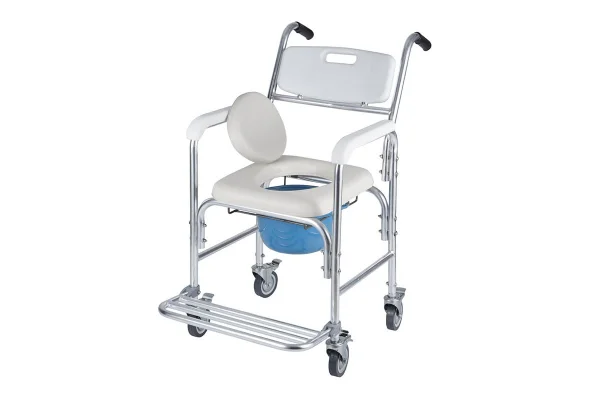
The material of the frame is just one of the many specifications that need to be determined when designing a chair. The structural design, connections, dimensions, intended use, and required performance evidence all need to be defined and verified in order to guarantee the performance of the complete chair.
No. A photograph shows visible features and a sample shows supplied parts. But neither can be verified for all claimed uses and their corresponding conditions by a photograph or sample only. Model-specific evidence and instructions are required, especially when several functions are supposed to be possible with one configuration.
They show which version of a specification or instruction was being used at a given point. This is helpful when components, product descriptions or packaging are updated. Comparing dated versions can reveal what changed without assuming that a shared model number means every detail is identical.
Bedside commodes are best understood through their intended uses, components and documented technical characteristics rather than a broad category label. The two model examples demonstrate how different constructions and stated functions call for configuration-specific information. Clear specifications, current instructions and appropriately scoped supporting evidence help distinguish confirmed features from assumptions. For businesses exploring bedside commode sourcing with Beiqin, a careful review of product specifications, configurations, and supporting documents provides a practical starting point for informed purchasing decisions.