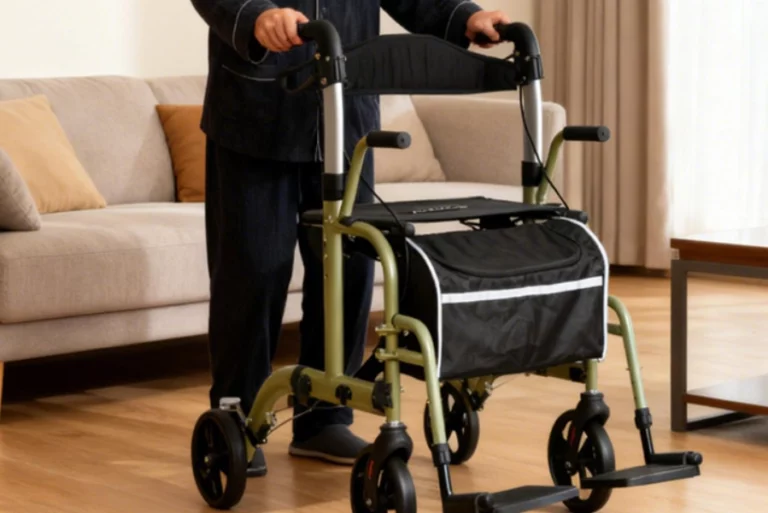
A stand up walker with seat can become more than one extra item in a rollator catalog. For distributors and medical equipment buyers, it can fill the space between a standard rollator, a tall walking aid, and a rest-ready mobility product for senior-care and rehabilitation channels.
The commercial question is not simply whether the product looks different. Buyers need to know how the upright support, armrest height, seat, brakes, packing data, documentation, and replenishment plan will work together as one sellable SKU. This article explains how to shape that kind of product program.
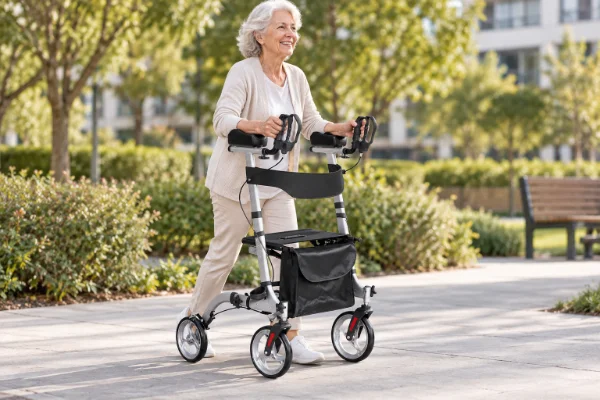
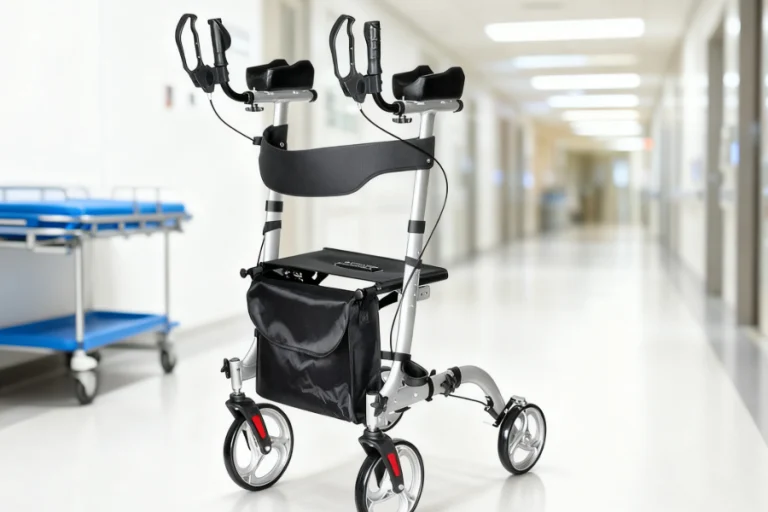
Many distributors already carry basic walkers and rollators with seats. An upright model gives the catalog a clearer posture-support option. The raised arm-support area helps position the product for users who prefer a more open walking posture, while the built-in seat gives the same product a rest function during longer indoor or paved-route use.
That role is useful for several B2B channels:
The phrase stand up walker with seat is broad in the market. Some suppliers use it for upright rollators with forearm support, while others use it for standard rollators with taller handles. Before a model becomes part of a catalog, the buyer should lock the model name, arm-support structure, seat description, brake function, and approved product images.
A stockable SKU needs more than a product photo. It needs a stable configuration that purchasing, sales, warehouse, and after-sales teams can repeat. For a stand-up walker, the most important file usually includes the model number, frame material, armrest height range, seat details, brake description, net and gross weight, load information, carton data, manual language, label artwork, and spare-part rules.
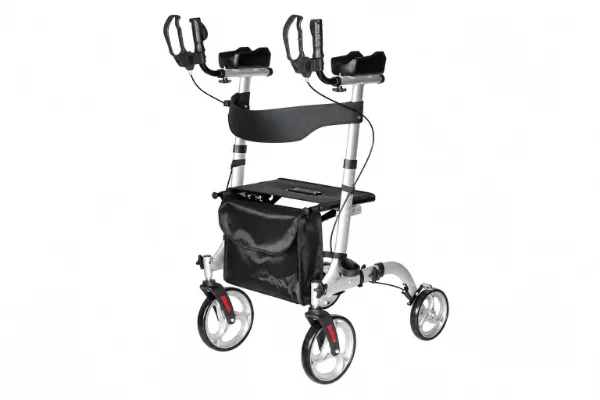
Beiqin’s medical aluminum stand up rollator with armrests is listed as model 1007B. The current listing describes an aluminum frame, adjustable padded armrests, a padded mesh seat with backrest, hand brakes with rear-wheel locking, and a listed maximum load of 136 kg. The published armrest height range is 43.5 to 48.4 inches from the ground.
For a wholesale order, these details should be repeated in the quotation and final specification sheet. If the product page, packing list, manual, and sales copy use different wording, the SKU becomes harder to train, ship, and support.
Price comparison is easier after the buyer defines the product position. A standard rollator, a folding upright rollator, and a stand up walker with seat may look similar in a quick spreadsheet, but they do not always compete in the same retail slot.
The 1007B type of product is best reviewed as an upright rollator with arm support and a rest function. That positioning affects the sales language:
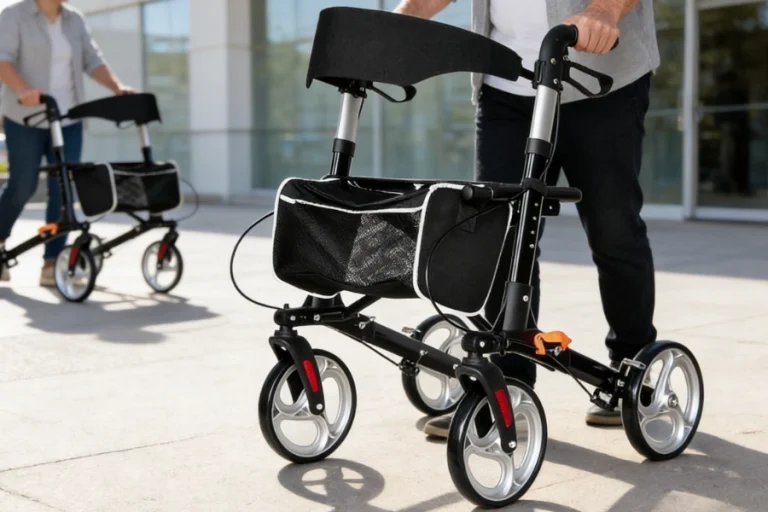
If a distributor needs a second option in the same family, the folding stand-up rollator with seat and armrests can be reviewed as a related upright model. If the channel needs a more familiar rollator format, the lightweight aluminum rollator with a seat may support a different price tier or retail explanation.
The table below can be used as a practical product-file framework. It is not a replacement for a signed quotation or final technical sheet.
| Product-file item | Current 1007B information | Why it matters for B2B buyers |
| Product identity | Medical aluminum stand-up rollator with armrests, model 1007B | Keeps quotation, catalog, invoice, and after-sales records aligned |
| Frame | Aluminum frame | Supports weight, handling, and freight comparisons |
| Arm support | Adjustable padded armrests, listed at 43.5 to 48.4 inches | Helps sales teams explain user fit and posture positioning |
| Seat | Padded mesh seat with backrest | Defines the rest function and affects product photos and instructions |
| Brake system | Hand brake with rear-wheel locking | Supports safety training and showroom demonstration |
| Listed load | 136 kg on the current product page | Must match the final approved test and destination-market documents |
| Packing weight | About 9.2 kg net and 10.2 kg gross | Helps buyers calculate handling, freight, and warehouse planning |
| MOQ | 100 pieces listed | Sets the starting point for trial orders and channel launch planning |
When private-label changes are added, the same file should also include logo placement, label language, manual version, carton marks, inspection points, and approved photos.
A distributor’s sample review should copy the way the product will be handled in the market. A showroom team may need to unfold it, adjust the armrests, explain the brakes, show the seat, and answer questions about indoor and paved outdoor use. A warehouse team may care more about carton strength, label visibility, and packed dimensions.
That is why sample approval should include both product handling and commercial readiness. The buyer should test steering, brake locking, seated rest, finish quality, armrest adjustment, and packaging protection. The same review should also check whether the manual, labels, and carton marks match the sales territory.
For brake and seat evaluation, Beiqin’s article on how importers should evaluate rollator brakes, seats, wheels, and load capacity gives a useful procurement angle. It helps the buyer move the conversation from appearance to testable product behavior.
Customization is more efficient when the supplier understands where the product will be sold. A medical equipment distributor may need conservative packaging and clear technical data. A retail brand may need cleaner carton design, simple comparison language, and product photography that fits an online listing. A rehabilitation supplier may ask for more detailed instructions and spare-part support.
For a stand up walker with seat, common OEM and ODM topics include:
Yongkang Beiqin Industry And Trade Co., Ltd.’s OEM and ODM rollator customization guidance is relevant when the buyer wants to build a stronger product line rather than place a one-time order. The earlier these details are confirmed, the easier it is to keep reorders consistent.
Yongkang Beiqin Industry And Trade Co., Ltd. manufactures age-adaptive assistive products, including upright rollators, standard rollators with seats, folding walkers, commode walkers, shower chairs, and safety rails. This wider range is useful when a distributor wants to combine mobility and daily-care products under one supplier relationship.
According to the supplied company profile, Beiqin has operated for more than 16 years, with a factory area above 20,000 square meters, more than 60 professional machines, four production lines, and production capacity above 6,000 units per day. The profile also states warehouse inventory of 180,000 units, 12-hour dispatch for available stock, 3-day sampling, and delivery of 10,000 units within 7 days under confirmed production conditions.
These figures should be treated as company-level capabilities. Buyers should still confirm the current stock, production slot, color availability, document package, and inspection plan for the exact model. A stand up walker with seat may share production resources with other rollator models, so the purchase order should state the approved specification clearly.
Instead of buying a product only because it appears in a catalog, distributors can build a cleaner launch plan:
First, define the channel. The same model may be presented differently to a medical supply shop, a senior-care retailer, or an online mobility-aid store.
Second, approve the sales-ready configuration. This includes the product itself, the manual, carton, label, listing copy, product photos, and the claims that sales teams are allowed to make.
Third, prepare replenishment rules. A buyer should decide what stock level triggers a reorder, how long a repeat order normally takes, and how specification changes will be approved.
Finally, keep the supplier conversation tied to documents. Model number, revision date, certification scope, and carton artwork should be visible in the order file. This reduces confusion when sales volume grows or when a new buyer takes over the account.
A stand up walker with seat is usually an upright rollator that places the user’s support points higher than many standard rollators and includes a seat for rest breaks. For B2B sourcing, buyers should confirm the armrest height range, seat structure, brake locking function, frame material, packing data, MOQ, and destination-market documents.
The 1007B can be discussed as a private-label candidate, subject to quotation, sample approval, artwork confirmation, and final production requirements. Buyers should confirm logo placement, manual language, product labels, carton marks, inspection standards, and whether the requested branding affects MOQ or lead time.
Before a bulk order, buyers should confirm the final specification sheet, current stock or production schedule, sample approval record, packaging artwork, certificate scope, inspection method, spare-part policy, and shipment plan. If the order includes custom branding, all artwork and label files should be approved before production.
A stand up walker with seat can strengthen a distributor’s mobility-aid range when it is treated as a full product program, not just a new catalog item. The buyer should define its channel role, approve the configuration, confirm documents, prepare sales language, and plan repeat supply before scaling the order.
Yongkang Beiqin Industry And Trade Co., Ltd. can support buyers who need upright rollators and related daily-care products from one manufacturing partner. To request the latest 1007B specification, sample details, OEM options, and quotation, contact Beiqin through the official contact page.